
Fever in Babies and Toddlers: What to Check and When to Seek Help
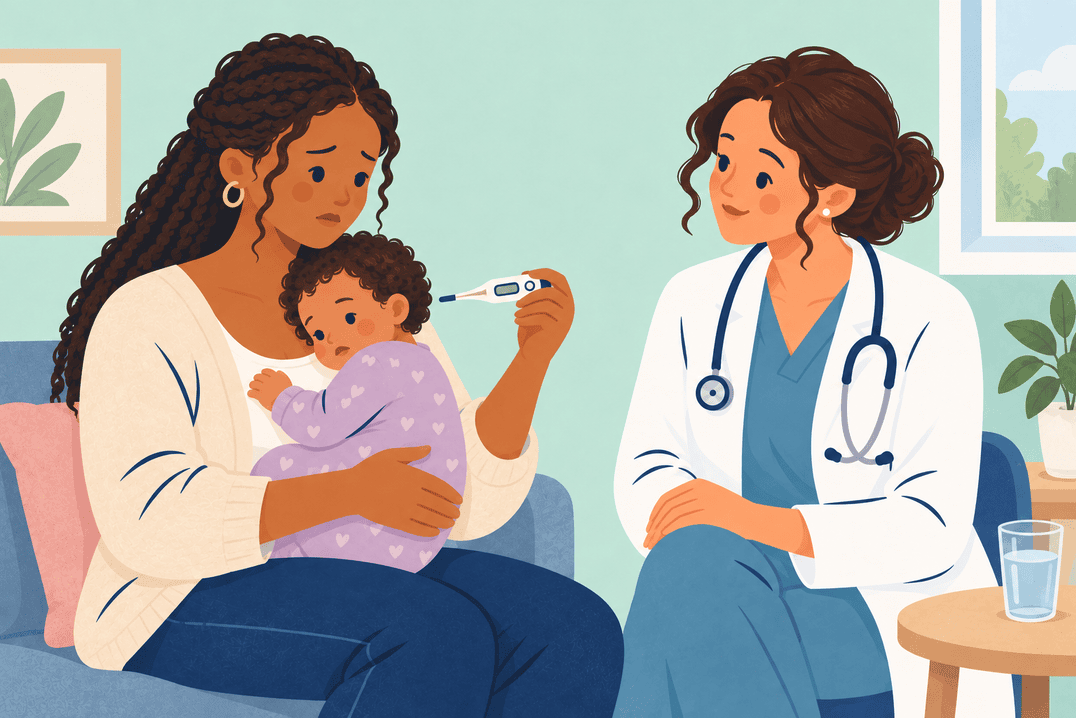
A baby in the first three months with a temperature of 38°C or higher needs immediate medical assessment, even if they seem comfortable. Breathing difficulty, difficulty waking, blue or grey colouring, or a first seizure needs emergency help at any age.
Fever is a sign to interpret alongside your child’s age, breathing, alertness and fluid intake. A toddler who is drinking and responding is a different situation from a newborn with the same reading. Neither a reassuring moment nor a lower temperature rules out serious illness.
Why a young baby’s age matters
Tell the clinician the baby’s exact age in weeks. UK guidance treats 38°C or above in babies under three months as particularly concerning. US paediatric guidance includes babies aged three months in its immediate assessment advice. If your baby is around this boundary, get help immediately rather than trying to decide which side of a birthday applies.
For babies aged three to six months, UK guidance identifies 39°C or higher as needing immediate medical assessment. Some local or individual care plans use lower thresholds. Contact a clinician promptly about fever in this age group, and seek help sooner for poor feeding, changed behaviour or any concern. Do not wait for the number to rise.
If fever follows vaccination, use the specific instructions from the vaccination team. Recent vaccination does not explain away breathing problems, difficulty waking or other serious symptoms. If you do not have a clear plan for your young baby, seek medical advice.
Check how your toddler is managing
In children older than six months, temperature height alone does not tell you how serious an illness is. Look at whether your child responds to you, can drink, passes urine and breathes without extra effort. Check regularly, including during the night, while following any care plan you have been given.
A quieter afternoon is different from being difficult to wake or not responding normally. Seek urgent advice if your child is getting worse, will not drink, passes much less urine, seems unusually drowsy or you remain worried. Fever lasting five days also needs assessment. This is a reason to review persistent fever, not an instruction to wait five days before asking for help.
Recognise symptoms that cannot wait
Use your local emergency service for struggling to breathe, pauses in breathing, a child who is hard to wake, a first seizure, or blue or grey lips or tongue. A rash that does not fade under pressure or a stiff neck with fever also needs emergency care. Do not wait for a rash to appear if your child is seriously unwell.
Start the call with the most concerning change: “My child is difficult to wake” is more useful than beginning with every temperature reading. Follow the emergency team’s instructions.
Measure and record without chasing a number
Use an appropriate digital thermometer and its instructions. Our guide to taking a baby’s temperature explains the differences between local recommendations and measurement methods. Record the reading, method and time. Do not invent a correction to turn one method into another.
If a child already has emergency symptoms, taking another reading must not delay help. Likewise, an improvement after fever medicine does not prove that the illness is harmless.
Offer comfort and fluids
Continue breast or formula feeds for babies, and offer a toddler regular drinks. Watch for dehydration, including fewer wet nappies or toilet visits. Offer food if wanted, without making a full meal the priority.
Dress your child comfortably. Avoid cold sponging, stripping them to cool them or wrapping them in extra layers. Suitable fever medicine may help a distressed child, but it is not needed solely to bring down a reading and does not prevent febrile seizures. Check the medicine guidance and the exact product instructions. Do not give aspirin to a child under sixteen unless prescribed.
When you speak to a clinician, have the child’s age, illness timeline, feeding, urine output and any medicines ready. Ask what changes should prompt another call and where to get help overnight. Seek help again if the situation changes, even after an earlier reassuring assessment.
References
- NHS: Fever in children (opens in a new tab)
- NHS: When to get urgent medical help for babies and children under five (opens in a new tab)
- NICE: Fever in children under five, assessment and initial management (opens in a new tab)
- NHS: How to take your baby’s temperature (opens in a new tab)
- American Academy of Pediatrics: Fever and your baby (opens in a new tab)
- NHS: Medicines for babies and children (opens in a new tab)
- NHS: Dehydration (opens in a new tab)

Lifeing Editorial
Stories for a little more understanding, a little more reassurance, and the everyday moments in between.
Related posts

Finding Your Fertile Window: How to Time Sex When Trying to Conceive