
Late period after travel: How Routine Changes May Play a Role
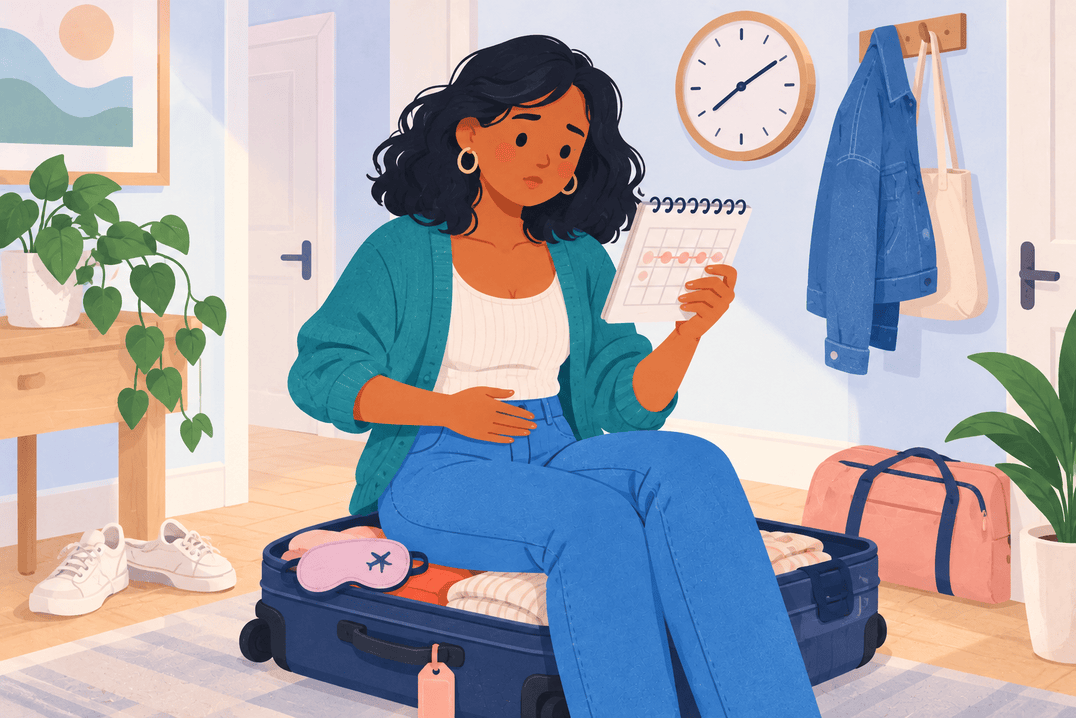
Travel can coincide with unfamiliar routines, disrupted sleep, stress, illness, or changes in eating and activity. Those details may be relevant to a delayed period. They do not prove that the journey caused it, and there is no dependable rule that crossing a time zone adds a set number of days to a cycle.
Keep the actual dates
Record when your last period began and whether your cycles were predictable before the trip. Keep an uncertain date marked as uncertain rather than entering what an app expected.
The period calculator guide explains why a forecast is an estimate. A change in location does not turn an old prediction into confirmation of when ovulation occurred.
Review pregnancy possibility independently
If pregnancy is possible, plan a test using the kit instructions. Do not dismiss that possibility because you have a plausible travel related explanation for the delay.
An early negative result may need repeating. Keep the date of the relevant sexual contact and the test date in the same note. The article on a negative test and no period explains when to ask for medical advice.
Note practical changes worth discussing
Mention illness, substantial weight changes, new medicines, or difficulty taking regular prescriptions during the trip. If you use contraception and are unsure about missed doses, ask a pharmacist or sexual health service for advice specific to your method.
Do not assume that every contraceptive has the same timing rules. Keep the product name available so the advice can be matched to what you actually use.
Return to a workable routine without demanding a result
Make room for regular meals, rest, and any ongoing treatment you need. These are practical recovery steps, not a promise that bleeding will begin on a particular day.
Seek assessment for repeated missing periods or other concerning symptoms. Bring the travel dates as context, while leaving room for the clinician to consider other explanations. You do not need to wait for another holiday or another cycle to ask about a change that worries you.
References

Lifeing Editorial
Stories for a little more understanding, a little more reassurance, and the everyday moments in between.
Related posts

Late periods in your forties: Pregnancy, Perimenopause, and Other Causes