
Teething Gels: Questions for a Pharmacist Before Use

Before buying a teething gel, describe your baby’s symptoms to a pharmacist or clinician. Not every unsettled baby is teething, and products sold for mouth pain can contain different medicines with different restrictions. A familiar brand name is not enough to establish that a product is suitable.
Try simple comfort first
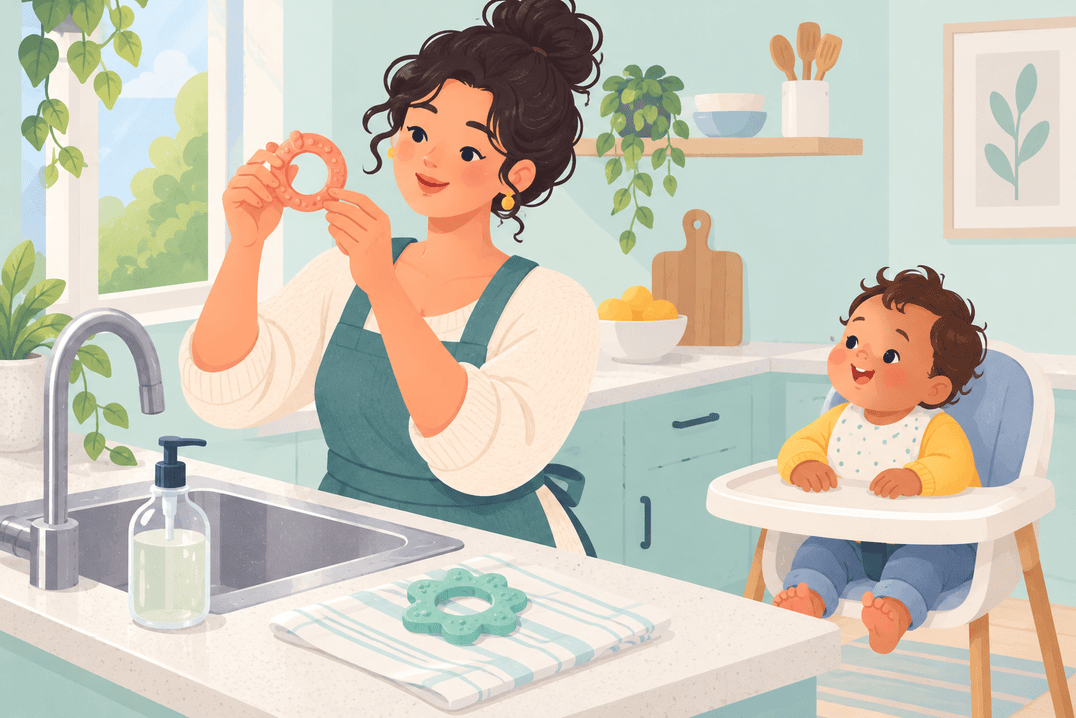
Gently massage the gums with a clean finger or offer an appropriate teether. Follow the teether’s instructions for cleaning and cooling; do not freeze it. Our guide to choosing teething toys covers the practical checks.
Gels are not a necessary step in normal tooth eruption. Evidence that teething gels help is limited, and saliva can quickly remove them from the gums. A child who remains very distressed needs an assessment of the symptoms rather than repeated applications of an ineffective product.
Check the exact ingredient and local advice
In the United States, guidance warns against benzocaine products and oral viscous lidocaine for teething. These can cause serious harm. Benzocaine can interfere with the blood’s ability to carry oxygen; swallowed or excessive lidocaine can cause severe reactions, including seizures and heart problems.
UK guidance has a different pathway for specifically licensed infant teething products containing lidocaine. These are supplied under pharmacist supervision, after simpler measures have not provided enough relief. That does not make adult oral gels, mouth ulcer treatments or a product bought abroad suitable for a baby.
Ask about the actual package in front of you, in the country where it will be used. Do not transfer instructions between products or assume a recommendation from another country applies to yours. If your pharmacist advises against a gel, ask what comfort or pain relief is appropriate instead.
Make the medicine discussion specific
Tell the pharmacist your child’s age, weight, symptoms, other medicines and any health conditions. Explain how long the discomfort has lasted and whether feeding or drinking has changed. Bring the packaging of anything already tried.
If a medicine is recommended, ask for its exact amount, how often it may be used and when to stop and seek reassessment. Follow that product’s instructions. Do not use more than one product containing lidocaine at the same time, and do not keep adding gel because it appears to have washed away.
For oral pain medicine, the suitable product and amount depend on age, weight and health. This article does not provide a dose. A pharmacist can also check whether a medicine already given contains the same ingredient under another name.
Avoid substitutes that carry their own risks
Do not apply alcohol to a baby’s gums. Homeopathic teething remedies are not a safer replacement, and some have contained potentially harmful ingredients. Products marketed as natural still need evidence of safety.
Beads and necklaces are not an alternative to medicine either. The teething jewelry guide explains their choking and strangulation risks.
Know when to get help
Seek emergency medical advice immediately if too much medicine may have been given or your baby may have swallowed a harmful product. Keep the packaging and do not wait for symptoms. Do not induce vomiting or offer food or drink while awaiting advice about suspected poisoning.
Breathing difficulty, a seizure, loss of consciousness or blue or gray coloring needs emergency help. Fever, diarrhea, poor feeding and marked lethargy should not be explained away by teething. The teething symptom guide helps you separate local gum discomfort from signs that need clinical attention.
References
- NHS: Tips for helping your teething baby (opens in a new tab)
- MHRA: Pharmacist supervision for infant teething products containing lidocaine (opens in a new tab)
- FDA: Safely soothing teething pain in infants and children (opens in a new tab)
- American Academy of Pediatrics: Teething pain relief (opens in a new tab)
- NHS: Poisoning (opens in a new tab)

Lifeing Editorial
Stories for a little more understanding, a little more reassurance, and the everyday moments in between.
Related posts

Teething Necklaces: Why Beads and Cords Are Unsafe