
White noise for babies: Questions About Volume and Placement
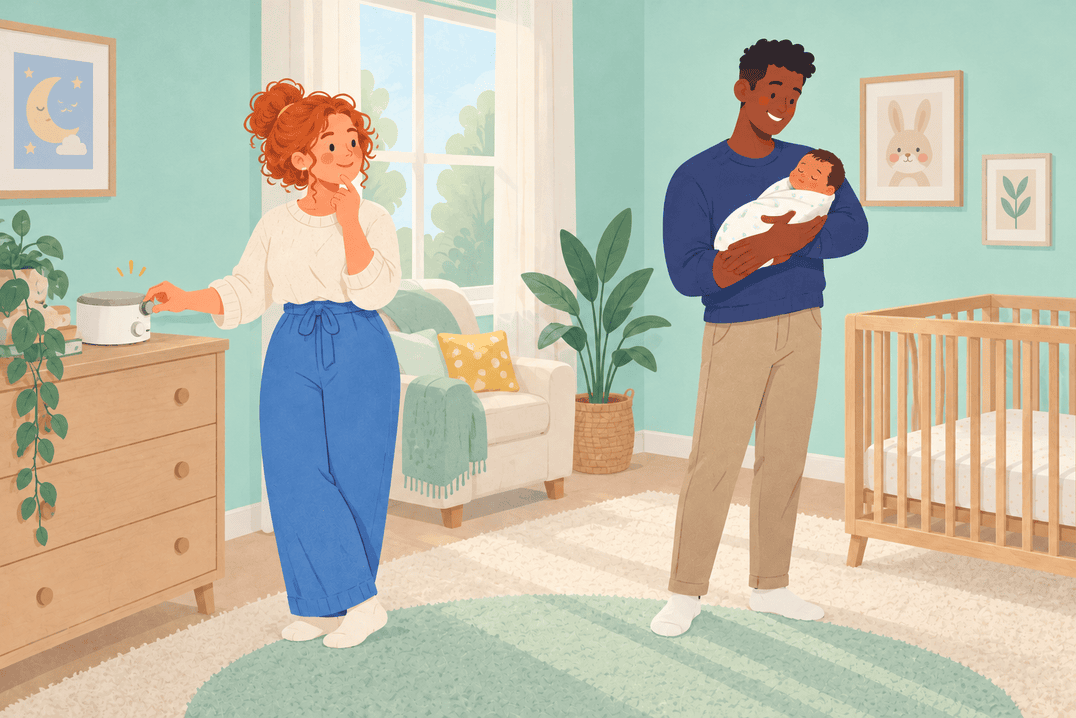
White noise machines are optional sleep accessories. Some families use a steady sound to cover household noise, but a product being sold for babies does not guarantee that every volume setting or placement is suitable. If you use one, think about sound exposure as carefully as where the device sits.
What the research can and cannot tell you
A laboratory study tested the maximum output of 14 infant sleep machines at different distances. Some produced sound levels that raised concern about potential hearing harm. This was a study of device output, not proof that every baby who has slept near a sound machine has hearing damage.
The findings also do not establish a single volume setting that is safe for every device, room and length of use. Adult occupational noise limits and hospital nursery recommendations are not interchangeable guarantees for a baby sleeping at home.
Use less sound, farther away, for less time
Pediatric guidance recommends keeping a sleep machine as far from the baby’s head as possible, choosing a low volume and limiting how long it runs. Avoid placing it beside the baby’s head or turning it up to compete with a television or other loud sound.
If reducing another noise is possible, do that first. For example, move a conversation to another room or switch off an unused television. Do not assume a machine needs to run throughout every nap and night because it helped once during settling.
Check the controls before each use, especially if someone else has changed them. A saved setting is useful only if you know what it does.
Keep equipment out of the sleep space
Place the device and its cord beyond your baby’s reach and outside the cot. Do not put a phone, speaker or power cable on the mattress. As your baby grows and reaches further, review the arrangement again.
Our room sharing guide covers practical cot placement. Sound does not replace a firm, flat, clear surface, back placement or the other safer sleep measures.
Keep the routine usable without a machine
A quiet voice, familiar song or brief cuddle can be part of a bedtime routine. You can make a simple note for other caregivers: where the device belongs, which control lowers the volume and when to turn it off. If you prefer not to use one, it is not a missing essential.
Ask about hearing concerns directly
If you are worried about your baby’s response to voices or sounds, ask their clinician for a hearing assessment. Passing a newborn hearing screen does not rule out a later hearing change.
Do not test hearing by playing increasingly loud noises near your baby. Bring the concern, and details of any significant noise exposure, to a professional. A sleep product cannot assess hearing or explain a change in responsiveness.
References
- American Academy of Pediatrics: How noise affects children (opens in a new tab)
- American Academy of Pediatrics: Preventing excessive noise exposure (opens in a new tab)
- Hugh and colleagues: Infant sleep machines and hazardous sound pressure levels (opens in a new tab)
- CDC: Hearing loss in children (opens in a new tab)
- NICHD Safe to Sleep: A safer sleep environment (opens in a new tab)
- Health Canada: Cribs, cradles and bassinets (opens in a new tab)

Lifeing Editorial
Stories for a little more understanding, a little more reassurance, and the everyday moments in between.
Related posts
Working on your feet while pregnant: Discussing Breaks and Adjustments