
Crawling variations: Understanding Different Ways Babies Move
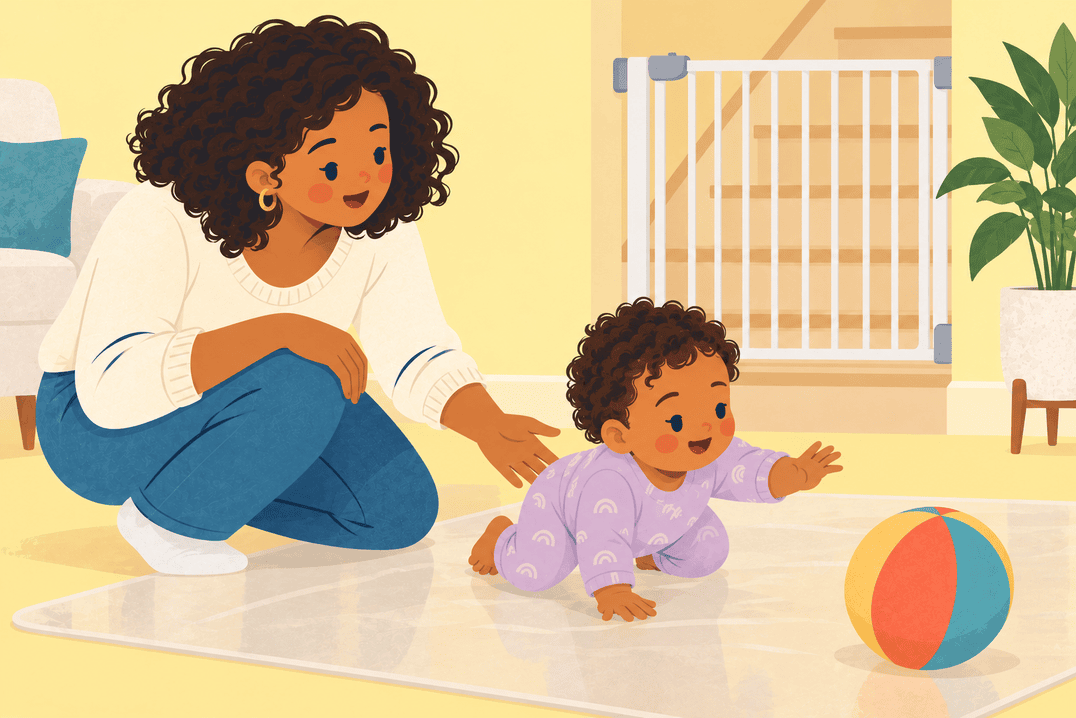
Babies do not all move across the floor with the same hands and knees pattern. Some use their tummy, roll to reach something, scoot on their bottom or move backwards before moving forwards. Look at your baby’s overall progress and comfort rather than judging development by one crawling style.
Observe the whole pattern of movement
Notice whether your baby uses both sides, reaches for toys, changes position and becomes more able to explore. Different styles can be part of development, but persistent difficulty using an arm or leg, apparent pain or loss of ability should not be dismissed as a personal preference.
Crawling is not included on the current nine month milestone checklist. Sitting without support and getting into sitting are among the movement skills most babies can do by that age. A missing skill or your own concern still deserves a conversation with a clinician. Our sitting guide explains those separate abilities.
Offer a clear space with useful things to explore
Set up a firm floor area where your baby can move freely with you nearby. Place a safe toy a small distance away and let them decide how to approach it. Keep the distance manageable and bring the toy closer if the activity becomes frustrating.
Join them on the floor and respond to their interest. You do not have to arrange a course or move their limbs through a crawling pattern. Short opportunities spread through the day can fit around feeding, rest and other care.
Our tummy time guide describes awake practice that supports early strength. Back play and reaching also have a place. If your baby has a medical condition or prescribed therapy, ask the team how to adapt floor activities comfortably.
Make the surroundings ready before speed increases
Check at floor level for coins, batteries, small toy parts and other choking hazards. Keep blind cords, electrical cables, medicines and cleaning products out of reach. Secure furniture and use suitable stair barriers before your baby can reach those areas.
Supervise exploration even in a room you have checked. A new movement can take your baby beyond the play area unexpectedly. The rolling guide explains why raised surfaces are unsafe even before crawling begins.
Avoid treating a style as something to correct yourself
There is no need to force a comfortable baby into a textbook pose solely because their movement looks different. At the same time, repeated dragging of one side, unusual stiffness or floppiness, or limited progress needs assessment. Do not rely on reassurance from a social media comparison.
Ask what skills the clinician expects next and when progress should be reviewed. For a premature baby, discuss corrected age. A checklist cannot account for every child’s history or replace examination when something concerns you.
Get support early when you are worried
Contact your health visitor or clinician rather than waiting for a particular crawling birthday. Explain what your baby does on the floor and whether that pattern is changing. Loss of an established skill needs prompt review. An individual assessment can identify useful support without promising that every baby will develop on the same timetable.
References
- American Academy of Pediatrics: Different crawling styles (opens in a new tab)
- CDC: Developmental milestones at nine months (opens in a new tab)
- CDC: Milestone monitoring and acting on concerns (opens in a new tab)
- NHS: Helping babies and toddlers stay active (opens in a new tab)
- NHS: Baby and toddler safety (opens in a new tab)
- American Academy of Pediatrics: Corrected age for premature babies (opens in a new tab)
- CDC: Movement concerns and early signs of cerebral palsy (opens in a new tab)

Lifeing Editorial
Stories for a little more understanding, a little more reassurance, and the everyday moments in between.
Related posts
Baby crying: Checking Common Needs One at a Time