
Hand and finger skills: Play Ideas for Grasping and Releasing
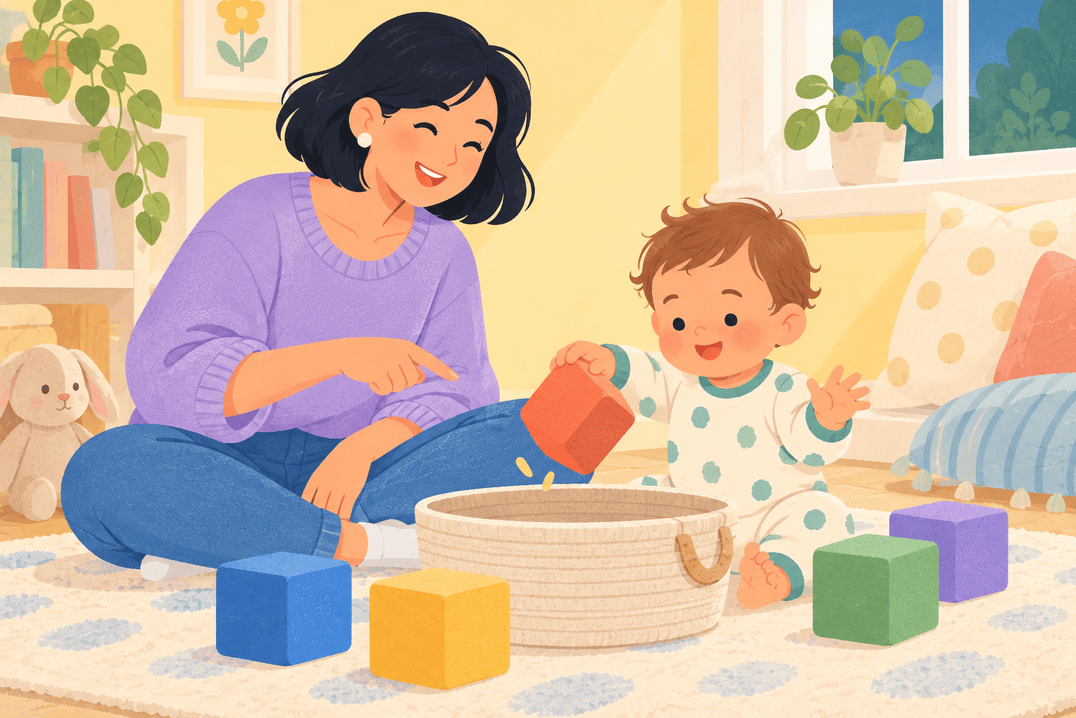
Babies use their hands to discover what objects feel like, how they move and what happens when they let go. You can support this learning with simple, safe toys and time together. A play session does not need to test every finger movement or produce a new skill.
Match the activity to the current stage
Early reaching and holding gradually become more purposeful. Later, you may see your baby move a toy from one hand to the other, hold something in each hand or drop an object while watching where it lands. These are different parts of hand development rather than one skill appearing all at once.
By nine months, most babies transfer objects between hands. By one year, putting an object into a container is another common milestone. If an expected ability is missing or you have other concerns, discuss it with your clinician instead of turning play into repeated testing.
Offer something easy to reach and hold
Choose an age appropriate toy that is light enough for your baby to handle and too large to be a choking hazard. Check for loose parts, damage and accessible batteries. Offer it where they can see it and allow time for them to reach.
Try presenting the toy near the middle of their body and, at other times, on either side. Let them choose how to explore. Do not force their fingers open or hold an object in their hand after they have tried to release it.
Make putting in and taking out a game
For a baby ready for this kind of play, use large baby safe blocks and a wide, stable container without sharp edges. Demonstrate placing one block inside, then give them a turn. They may prefer taking everything out or dropping a block beside the container.
Describe what happened and offer another opportunity. The aim is exploration, not accuracy. Our pincer grasp guide explains how thumb and finger control develops without using tiny craft items as practice materials.
Give the body enough support
A baby working hard to stay upright may have less freedom to reach comfortably. Play on the floor in a position they can manage, with appropriate support and supervision. Our sitting guide explains why an apparently steady sit may still need an adult close by.
Offer varied awake positions and stop when your baby becomes tired or upset. Keep toys out of the sleep space. You do not need weights, resistance equipment or a routine designed for older children to encourage ordinary infant hand play.
Notice differences that need discussion
Speak with a clinician if one hand is consistently less active, your baby seems unable to open it, movements appear painful or progress has stalled. The hand preference guide explains why an early strong preference deserves attention. Lost skills need prompt assessment.
A brief description of what you see is useful: “They reach with the right hand every time and rarely open the left.” Keep offering comfortable play while you arrange advice, but do not restrain the more active hand or start a therapy programme without individual professional guidance.
References
- CDC: Developmental milestones at four months (opens in a new tab)
- CDC: Developmental milestones at six months (opens in a new tab)
- CDC: Developmental milestones at nine months (opens in a new tab)
- CDC: Developmental milestones at one year (opens in a new tab)
- NHS Best Start in Life: Play, reaching and coordination (opens in a new tab)
- East of England Community Health and Care NHS Trust: Grasping, release and hand skills (opens in a new tab)
- NHS: Baby and toddler safety (opens in a new tab)
- CDC: Getting help with developmental concerns (opens in a new tab)
- NICE: Referral for childhood movement delay, regression and asymmetry (opens in a new tab)

Lifeing Editorial
Stories for a little more understanding, a little more reassurance, and the everyday moments in between.
Related posts

Head control: Following Your Baby's Growing Strength