
Bilingual toddlers: Supporting Both Languages at Home
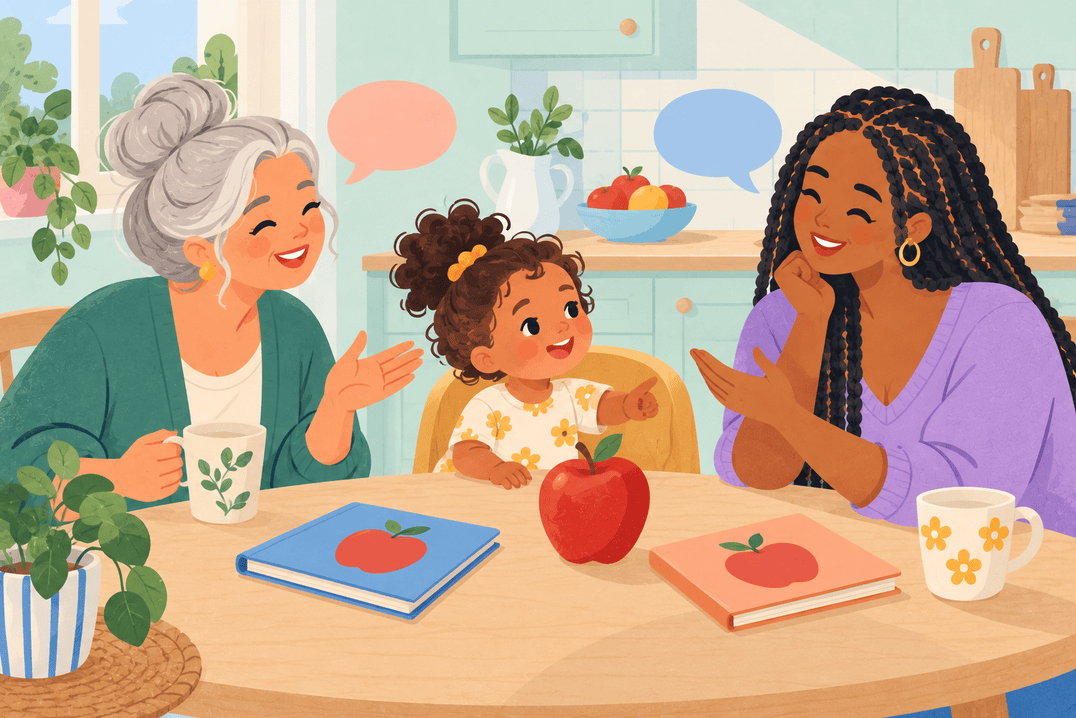
A toddler can learn more than one language through relationships and everyday life. Using your family languages does not confuse a child or cause a speech or language disorder. Speak with them in the languages you feel comfortable using, including the language that connects them with relatives and community.
Choose a routine your family can sustain
There is no requirement that every household divide languages in the same way. One caregiver may use one language more often; another family may change language with the setting or the people present. Choose opportunities that feel natural and are available regularly.
For example, a grandparent might tell a familiar story in one language while another caregiver uses a different language during breakfast. These are chances for real interaction, not lessons your child must pass. You do not need identical amounts of every language in every activity.
Make room for uneven knowledge
Your toddler may know some words in one language and other words in another, depending on their experiences. They may also use one language more readily at a particular time. Language strengths can change as their everyday surroundings change.
Mixing languages within a conversation can be part of multilingual development. Respond to what your child is trying to say rather than treating each mixed sentence as an error. Our vocabulary guide explains why examples from all languages matter when discussing progress.
Give the less used language meaningful company
Look for people and activities that make a language useful and enjoyable. A regular conversation with a relative, a favourite song or a familiar picture book can create a reason to join in. Avoid making access to affection or play depend on answering in the language you request.
Our reading guide includes ways to share a book without following every printed word. You can describe the pictures in your own language. Keep family interactions warm even when your toddler replies using another language.
Do not explain away a concern as bilingualism
Learning several languages is not a reason to postpone checking a communication difficulty. Mention limited understanding, little progress, difficulty making needs known, hearing concerns or lost skills. A language disorder can affect the languages a child uses, although it may look different in each one.
The late talking guide describes hearing and language review. Ask the service to consider all languages and your child’s exposure to them, using an appropriately skilled clinician or interpreter where needed. An English only snapshot may not represent what your child can do.
Keep family languages during support
If your child needs therapy, ask how activities can work across their languages and daily routines. A diagnosis is not an automatic reason to stop using your heritage language. Share which people your child needs to communicate with and what matters to your family.
Bring short examples of things your child says or understands in different settings. These can help professionals plan support without expecting you to assess the child yourself. The aim is useful communication and connection, with help for any difficulty that needs it.
References
- ASHA: Learning more than one language (opens in a new tab)
- American Academy of Pediatrics and ASHA: Young children learning multiple languages (opens in a new tab)
- NHS: Helping your baby learn to talk (opens in a new tab)
- ASHA: Communication milestones and their limits (opens in a new tab)
- NIDCD: Speech, language and developmental assessment (opens in a new tab)
- CDC: Getting help with developmental concerns (opens in a new tab)

Lifeing Editorial
Stories for a little more understanding, a little more reassurance, and the everyday moments in between.
Related posts
Birth debriefs: Asking for an Explanation of What Happened