
Reading to babies: Making Books Part of Everyday Interaction
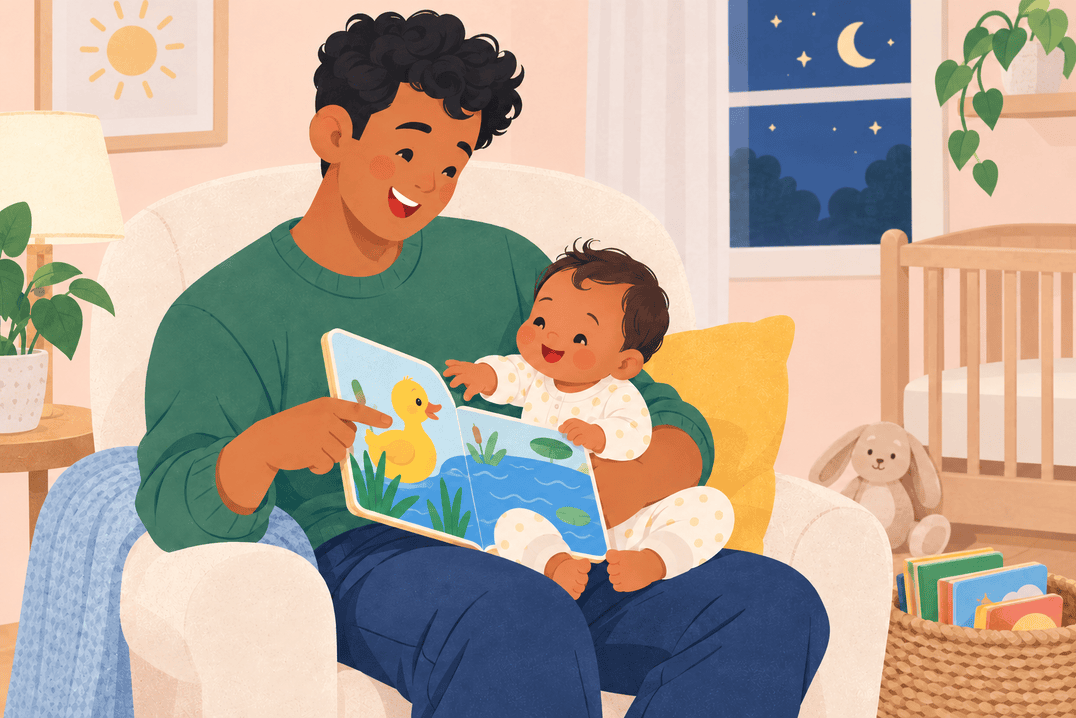
You can share a book with a baby long before they understand a story. Your voice, the pictures and the time together are all part of the experience. A few comfortable moments with a page can be worthwhile even when the book stays unfinished.
Start with a moment that fits
Choose a time when your baby is awake and reasonably comfortable. Hold or position them safely with the support they need, where you can both look at the book. A hungry, tired or upset baby may need care before a story.
You might keep one book near your usual sitting place and offer it after a change or during quiet play. There is no need to make every attempt last the same number of minutes. A brief shared look is a reasonable place to start.
Talk about the part they notice
If your baby looks at a picture, describe it in a few words. Make a gentle animal sound or notice a colour without expecting an answer. Pause to see whether they look, reach, move or make a sound in response.
Our early communication guide explains how these exchanges can become little conversations. You can skip printed sentences, return to the same picture or let your child choose another page. Reading together need not become a test of naming objects.
Choose books they can explore safely
Sturdy pages and simple pictures can make a book easier to handle. Check it for torn pieces, loose decorations or damaged parts, especially when your baby puts objects in their mouth. Supervise exploration and follow any product age guidance.
Sound features are optional. If a book uses batteries, its compartment must be secure and inaccessible to the child. Keep books and other play materials out of the baby’s sleep space when the reading time ends.
Let repetition and family language belong
A favourite page may be requested many times. You can enjoy that familiarity without feeling obliged to introduce a new title at every sitting. Small changes in your comments may come naturally as your child notices more.
Use the languages you know well. A book printed in another language can still become a conversation about pictures in your own. Borrowing suitable books from a library can give you choices without needing a large collection at home.
Adapt the experience to your child
Some children need help holding a book, a different position, clearer pictures or support to access sound. Ask your child’s care team about adaptations for hearing, vision, movement or developmental needs. Participation may be a movement or expression rather than a spoken answer.
Our gesture guide offers ways to notice those messages. Let your child take a break when they turn away or become uncomfortable. Do not require stillness or eye contact as the price of sharing the story.
Keep books as shared play
As your child grows, a picture may inspire a simple game, such as pretending a toy animal is going to sleep. Our pretend play guide describes how to join without directing every action.
Books support enjoyable interaction, but they do not replace assessment for hearing, communication or developmental concerns. If a skill is missing or lost, or something worries you, ask for advice rather than adding reading sessions as a treatment on your own.
References
- American Academy of Pediatrics: Sharing books with babies (opens in a new tab)
- American Academy of Pediatrics: Sharing books with children who have additional needs (opens in a new tab)
- NHS Best Start in Life: Early sounds and everyday interaction (opens in a new tab)
- ASHA: Learning more than one language (opens in a new tab)
- East of England Community Health and Care NHS Trust: Toy safety (opens in a new tab)
- CDC: Getting help with developmental concerns (opens in a new tab)
- American Academy of Pediatrics: Safe sleep recommendations (opens in a new tab)

Lifeing Editorial
Stories for a little more understanding, a little more reassurance, and the everyday moments in between.
Related posts

Ready to feed versus powdered formula: Choosing a Practical Format