
Pretend play: Joining Your Child’s Imagination
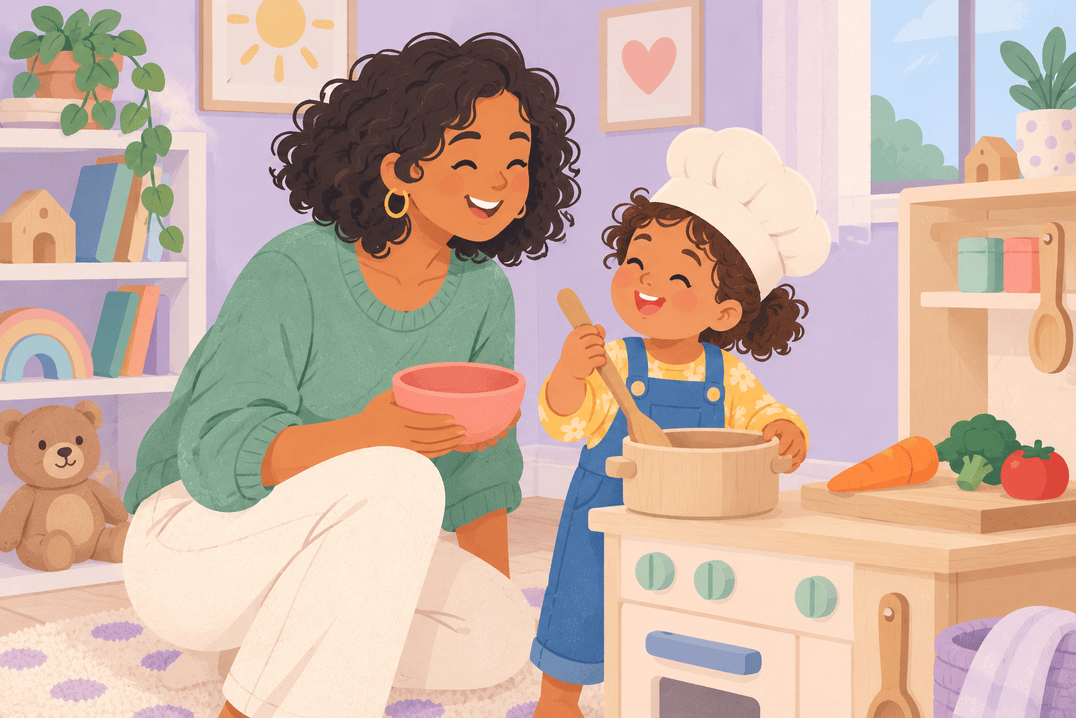
Pretend play can be very small: a toddler offers an empty cup, settles a toy animal or makes a vehicle travel to an imagined destination. You can join by responding to the idea they offer. There is no need to turn it into a detailed story or a performance with a correct ending.
Start with something familiar
Choose one routine your child has seen, such as washing, eating or going out. Use suitable toys to act out one simple moment. You might give a toy animal a pretend wash with an empty cup, then wait to see what your child does.
They may copy you, change the activity or simply inspect the objects. Follow what holds their interest rather than insisting they demonstrate imagination on request. Our toddler play ideas include simpler activities when a pretend scene does not appeal.
Add one idea rather than a whole script
If your child drives a toy vehicle, you might place a large block nearby as a destination. If they put a doll down, you can quietly say that the doll is resting. Leave space for them to accept, ignore or change that suggestion.
Avoid asking a question after every action. A few comments and a pause often leave more room for your child than a stream of directions. You can take part without controlling where the story goes or correcting an unusual use of a toy.
Let words, gestures and actions all contribute
A child may offer you a cup without saying anything, or use a sound to show a vehicle moving. Respond to the message they are making. Our gesture guide explains why communication is more than a spoken sentence.
A familiar picture book can suggest another little scene, but copying the book exactly is unnecessary. The reading guide offers ways to follow a child’s interest in one picture. The game can finish whenever they have had enough.
Keep imaginary materials physically safe
Use objects suitable for your child’s age and abilities. Check toy parts, batteries and damage. Avoid real medicines, cleaning containers, sharp utensils, loose magnets or other household hazards, even when the proposed activity is only pretend.
Keep play away from hot cooking areas and open flames. Do not use cords or long ties as costume accessories. If a child still mouths objects, tiny pretend food is unsuitable. An adult nearby cannot remove the choking risk of a small part already in the mouth.
Look at development without testing every game
Simple pretend actions can emerge during the second year, while more varied use of one object to represent another develops over time. By thirty months, using an object imaginatively is a common milestone. This is not a reason to wait until that age if communication or play already concerns you.
Discuss absent expected skills, limited progress or loss of a previously established ability with your clinician. Adapt play for sensory or movement needs with professional advice when useful. A favourite repeated scene or refusal to join one game is not a diagnosis on its own; the wider developmental picture matters.
References
- East of England Community Health and Care NHS Trust: Playing and social skills (opens in a new tab)
- NHS Best Start in Life: Toddler play and connection (opens in a new tab)
- CDC: Developmental milestones at eighteen months (opens in a new tab)
- CDC: Developmental milestones at thirty months (opens in a new tab)
- CDC: Developmental milestones at two years (opens in a new tab)
- East of England Community Health and Care NHS Trust: Toy safety (opens in a new tab)
- NHS: Accessible toys and play (opens in a new tab)
- CDC: Getting help with developmental concerns (opens in a new tab)
- NHS: Baby and toddler safety (opens in a new tab)

Lifeing Editorial
Stories for a little more understanding, a little more reassurance, and the everyday moments in between.
Related posts

Preterm labor signs: When to Contact Your Maternity Team