
Cruising along furniture: Supporting Exploration Safely
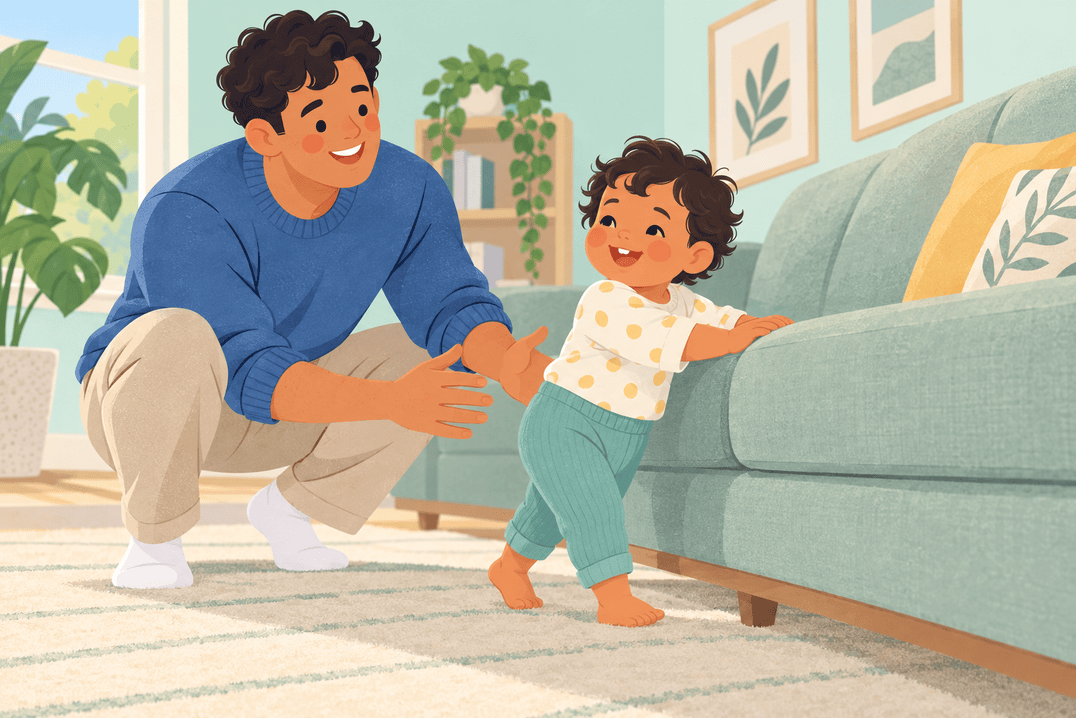
Cruising means moving while holding furniture or another stable support. Your baby may take small sideways steps, pause to look around and then sit down again. This gives them a way to explore upright before walking independently, but it does not predict the exact day they will let go.
Start with a secure stretch of furniture
A stable sofa can provide a place to hold while your baby stands on the floor. Make sure it cannot shift under their weight and that nearby furniture and televisions are properly secured. Remove sharp, hot or breakable objects from the route and keep cords out of reach.
Do not use a lightweight chair, folding table or object on wheels as the main support. Our pulling to stand guide covers preparing the home for this new reach. Check the whole area your baby could access, not just the spot where you begin.
Invite a small sideways movement
Sit or kneel nearby and place a safe toy a little to one side along the support. Give your baby time to decide whether to move towards it. You can talk about the toy or offer a smile without repeatedly moving it farther away.
Try both directions over different play sessions. Do not pull your baby’s hands off the furniture, move their feet for them or insist they continue when tired. A comfortable pause or return to sitting is part of ordinary exploration.
Keep transitions manageable
Moving between supports adds another balance challenge. If your baby is beginning to do this, use secure surfaces close enough for them to reach comfortably while you stay ready to help. Avoid creating a large gap to force independent steps.
The room does not need to become a training course. Short moments during everyday play are enough to offer opportunities. Let your baby choose floor movement when they prefer it, and keep space for crawling, rolling or sitting as well as standing.
Think about feet and falls
On a safe, warm indoor floor, barefoot practice can help your baby feel the surface. Keep the route clear of small objects and slipping hazards. Shoes may be needed for protection outside; they should fit well and allow room for the toes.
Stay close because holding on does not prevent every fall. Block access to stairs, windows and unsafe areas before your baby can reach them. Being able to cruise does not mean they can judge an edge or recover balance reliably.
Discuss concerns without waiting for independent walking
By one year, most babies can move while holding furniture. If your baby is not showing the expected skill, progress seems limited or they consistently avoid using one side, ask your clinician. Mention pain, stiffness or unusual floppiness, and seek prompt assessment for lost skills. Ask about corrected age if they were born early.
Our first steps guide looks at comfortable opportunities as balance grows. If you are wondering whether a delay needs attention, the late walking guide explains how to prepare that conversation. You do not need to wait until a later birthday when something already worries you.
References
- CDC: Developmental milestones at one year (opens in a new tab)
- East of England Community Health and Care NHS Trust: Learning to walk (opens in a new tab)
- US Consumer Product Safety Commission: Anchoring furniture and televisions (opens in a new tab)
- NHS: Baby and toddler safety (opens in a new tab)
- NHS: Children’s feet and choosing first shoes (opens in a new tab)
- CDC: Getting help with developmental concerns (opens in a new tab)
- American Academy of Pediatrics: Corrected age for premature babies (opens in a new tab)
- NICE: Referral for childhood movement delay, regression and asymmetry (opens in a new tab)

Lifeing Editorial
Stories for a little more understanding, a little more reassurance, and the everyday moments in between.
Related posts
Crying that sounds different: When to Seek Urgent Advice