
Pulling to stand: Making the Home Safer for New Skills
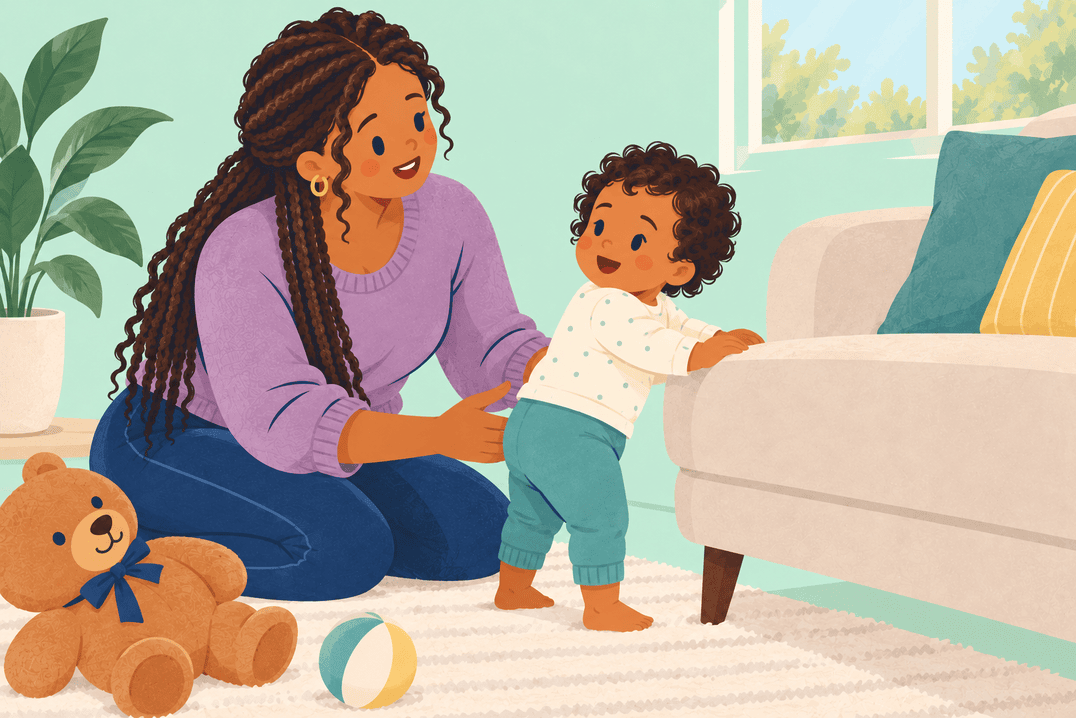
Pulling to stand brings shelves, tabletops and other surfaces within reach. The first attempt can arrive before you expect it, so prepare the room while your baby is still mainly playing on the floor. Safe surroundings let you respond to their interest without constantly moving hazards at the last moment.
Check what can move or tip
Choose a stable support that cannot slide, fold or tip when your baby pulls on it. Secure furniture and televisions using suitable anchoring hardware and the manufacturer’s instructions. A heavy appearance does not prove that an item cannot topple.
Move tempting objects away from higher shelves. Keep hot drinks, medicines, cords and breakable items beyond reach, and avoid a tablecloth that could bring objects down when pulled. Check other homes where your baby spends time as well as your own.
Offer a reachable reason to rise
If your baby is already trying to pull up, place a favourite safe toy on a stable low surface such as the sofa seat, with your baby on the floor. Stay close enough to help with balance. The aim is to invite their own movement, not to lift them by the hands until they appear to stand.
Let them return to floor play when they are tired or uninterested. Our sitting guide describes earlier changes in trunk control. Babies need a variety of comfortable positions rather than spending every play session upright.
Help with the return to the floor
Getting up and getting down can feel like separate challenges. If your baby becomes upset while holding on, support their body and help them lower safely. Do not leave them standing until they work it out or suddenly remove their support to test their balance.
Keep the floor clear and stay nearby. A firm play surface is easier to move on than a pile of cushions, and cushions are not a substitute for supervision. You can pause, cuddle and try again another time.
Review the sleep space now
Follow the cot instructions for lowering the mattress as your baby becomes more mobile. This often needs to happen before pulling to stand, once a baby can sit or push up on hands and knees. If you have not checked the setting recently, do so now.
Remove mobiles and toy bars when the product instructions or your baby’s development require it. Keep the cot clear of items that could become a climbing step. Do not use a restraint or cot tent to prevent climbing, and follow the product’s limits for when to move to another bed.
Use milestones to start a conversation
By one year, most babies pull themselves up to stand. If your baby is not showing the expected skill, has difficulty using both sides or seems unusually stiff or floppy, ask your clinician about assessment. For a baby born early, discuss corrected age. Lost skills need prompt review.
Our cruising guide covers moving sideways along a support. The baby walker guide explains why a wheeled seated walker is not a shortcut to these skills.
References
- CDC: Developmental milestones at one year (opens in a new tab)
- East of England Community Health and Care NHS Trust: Learning to stand (opens in a new tab)
- US Consumer Product Safety Commission: Anchoring furniture and televisions (opens in a new tab)
- NHS: Baby and toddler safety (opens in a new tab)
- Health Canada: Cribs, cradles and bassinets (opens in a new tab)
- CDC: Getting help with developmental concerns (opens in a new tab)
- American Academy of Pediatrics: Corrected age for premature babies (opens in a new tab)
- CDC: Movement concerns and early signs of cerebral palsy (opens in a new tab)

Lifeing Editorial
Stories for a little more understanding, a little more reassurance, and the everyday moments in between.
Related posts

Pumping schedules: Matching Expression to Your Feeding Goals