
Language support at nursery: Sharing What Works at Home
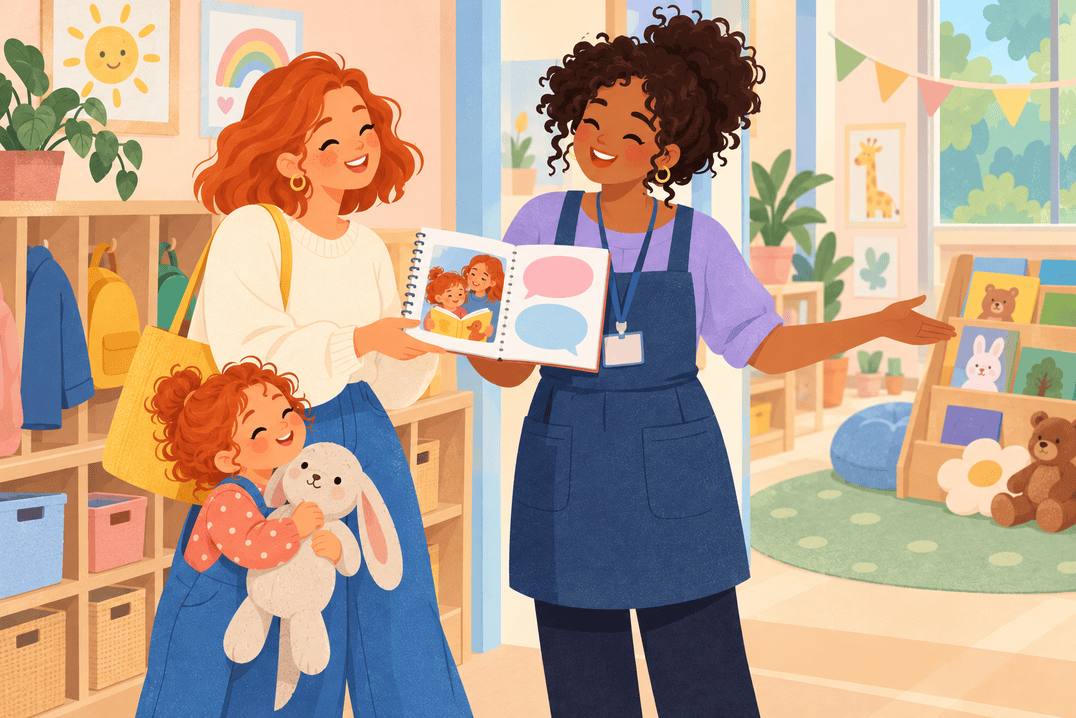
Your child’s communication at nursery may look different from what you see at home. Sharing both views can help adults understand what makes communication easier and where support is needed. Start with a conversation with the child’s key person, without waiting to produce a perfect account.
Share what already works
Describe how your child asks for help, chooses an activity or shows that something is uncomfortable. Include gestures, sounds and words. Explain any familiar word that staff might not recognise and how you usually respond.
For example, your child might bring a cup when thirsty or use a shortened word for a comfort toy. These details give staff a practical starting point. Ask them for equivalent examples from nursery, such as joining snack time or asking another child for a turn.
Make family languages visible
Tell staff which languages your child hears, who uses them and where your child is most comfortable communicating. A small set of useful words or a familiar song can help adults connect daily routines. Check pronunciation together rather than assuming a written translation tells the whole story.
Families do not need to stop using a home language to support nursery English. Our bilingual toddler guide explains why language exposure and skills across languages matter. If assessment is needed, ask about appropriate professional language or interpreter support.
Agree on a few everyday approaches
Choose manageable actions that can fit both settings. These might include pausing after a short comment, offering a simple choice and responding to a gesture with a useful word. Familiar books, songs and play can give children reasons to communicate without turning every interaction into a quiz.
Ask where communication is hardest. If a busy group makes listening difficult, discuss a quieter place for some interaction. If a therapist has recommended pictures, signs or another communication aid, ask how the same approach will be available throughout the day.
Record support in a useful form
A brief shared note can include the approaches you agreed, who will coordinate them and when you will compare observations. You could ask, “Can he show someone he needs help?” rather than setting an arbitrary number of new words for the week.
Make room for strengths as well as difficulties. If your child joins in more readily with one familiar adult or activity, that is useful information. The note should help people respond, rather than become a daily pass or fail report for the child.
Act on concerns alongside nursery support
If understanding, speech or interaction is not developing as expected, speak with your health visitor, GP or speech and language service. A nursery plan can support your child while assessment is arranged. It should not be used to postpone help indefinitely or assume that every difficulty is simply settling in.
Our late talking guide describes the assessment discussion. Mention hearing concerns even if the newborn screen was passed. Report any loss of established skills promptly. Ask who will make each referral and how you will hear about the next step.
References
- Leeds Community Healthcare NHS Trust: Communication support at home and nursery (opens in a new tab)
- NHS: Helping your baby learn to talk (opens in a new tab)
- American Academy of Pediatrics and ASHA: Young children learning multiple languages (opens in a new tab)
- ASHA: Learning more than one language (opens in a new tab)
- American Academy of Pediatrics: Language delays and assessment (opens in a new tab)
- NIDCD: Hearing screening and ongoing hearing checks (opens in a new tab)
- CDC: Getting help with developmental concerns (opens in a new tab)

Lifeing Editorial
Stories for a little more understanding, a little more reassurance, and the everyday moments in between.
Related posts


Late talking: When to Ask for a Hearing and Language Review