
Nineteen month old toddler: Supporting Communication During Big Feelings
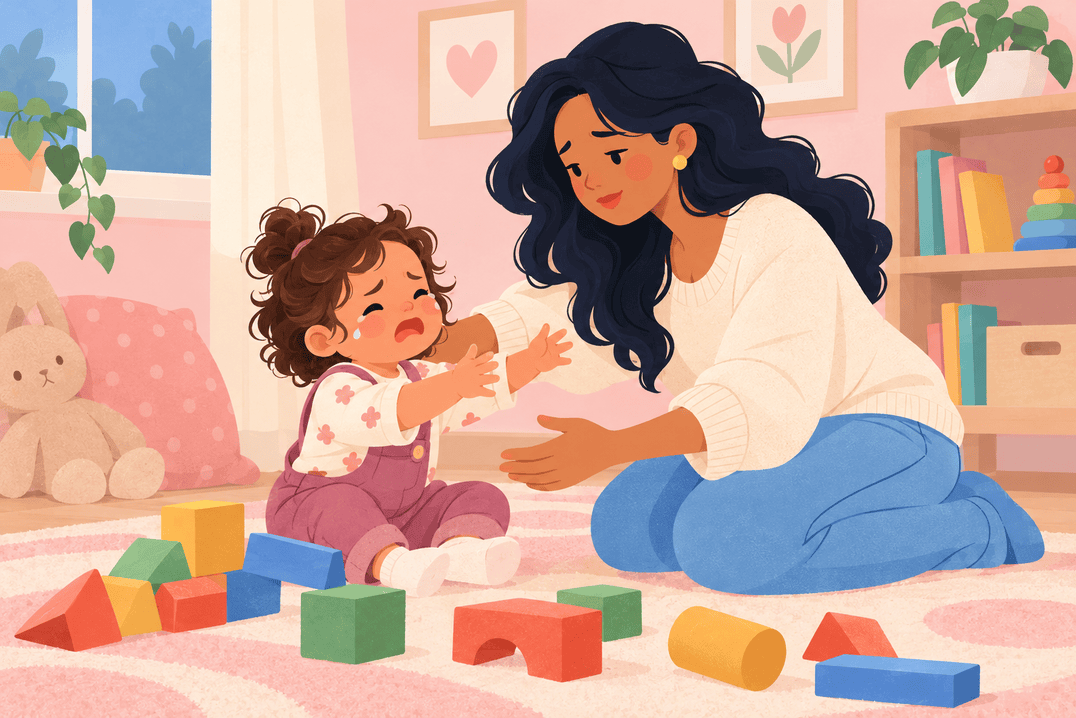
At nineteen months, a toddler may know what they want before they can explain it. Frustration can build quickly when an adult misunderstands, an activity ends or a familiar routine changes. You can make communication easier while continuing to protect your child and other people.
Start by reducing the immediate difficulty
When your child is very upset, keep your words brief and your voice calm. Stay available and help them move away from danger. If another child is being hurt, intervene promptly and create safe space between them.
A long lesson about sharing can wait until everyone is calmer. Our big feelings guide explains how to combine reassurance with a necessary limit. Comfort does not mean allowing hitting or handing over something unsafe.
Offer a way to show what they mean
Pointing, looking, reaching and familiar gestures can help you understand a request. Name the likely need in a short phrase and give your child a chance to respond. If you misunderstood, try again without treating the confusion as deliberate misbehaviour.
Our gesture guide explains how these signals fit with spoken language. Do not make food, comfort or help conditional on saying a word clearly. You can model useful words such as help or more while responding to the need.
Look for a pattern around difficult moments
A brief note can show whether upset often follows a missed nap, hunger, a noisy setting or a particular transition. Use that information to make the next situation easier where possible. It is not a scorecard of good and bad behaviour.
Share practical observations with other caregivers. A consistent short phrase or a little extra transition time may be easier to use than a complicated plan. If an approach is making distress worse, review it rather than repeating it more forcefully.
Keep language concerns visible
Nineteen months follows the eighteen month checkpoint. Missing earlier communication skills should not be explained away as temperament. Ask for advice if your child has few word attempts, seems not to understand familiar requests or appears not to hear some sounds.
Language assessment can consider understanding, expression, gestures and hearing together. Frustration alone does not identify a language disorder, and a toddler with good spoken language can still need substantial help with feelings.
Seek support before family life becomes unmanageable
Tell your clinician if aggression causes injuries, you fear for someone’s safety or distress repeatedly disrupts everyday activities. You can ask for help sooner than any fixed duration suggests. Support may involve understanding communication, sleep, health and the environment as well as behaviour.
If a skill your child previously used disappears, seek prompt assessment rather than assuming the difficult phase will explain it. The aim is to understand what support is needed, while keeping daily interactions calm, predictable and safe.
References
- CDC: Developmental milestones at eighteen months (opens in a new tab)
- CDC: Developmental milestones at two years (opens in a new tab)
- NHS Best Start in Life: Helping toddlers with emotions (opens in a new tab)
- American Academy of Pediatrics: Responding to aggression in young children (opens in a new tab)
- NHS: Helping your baby learn to talk (opens in a new tab)
- American Academy of Pediatrics: Language delays and assessment (opens in a new tab)
- CDC: Getting help with developmental concerns (opens in a new tab)

Lifeing Editorial
Stories for a little more understanding, a little more reassurance, and the everyday moments in between.
Related posts

NIPT screening: Understanding What the Result Can and Cannot Tell You