
Positive Attention: Noticing the Behaviors You Want to Encourage
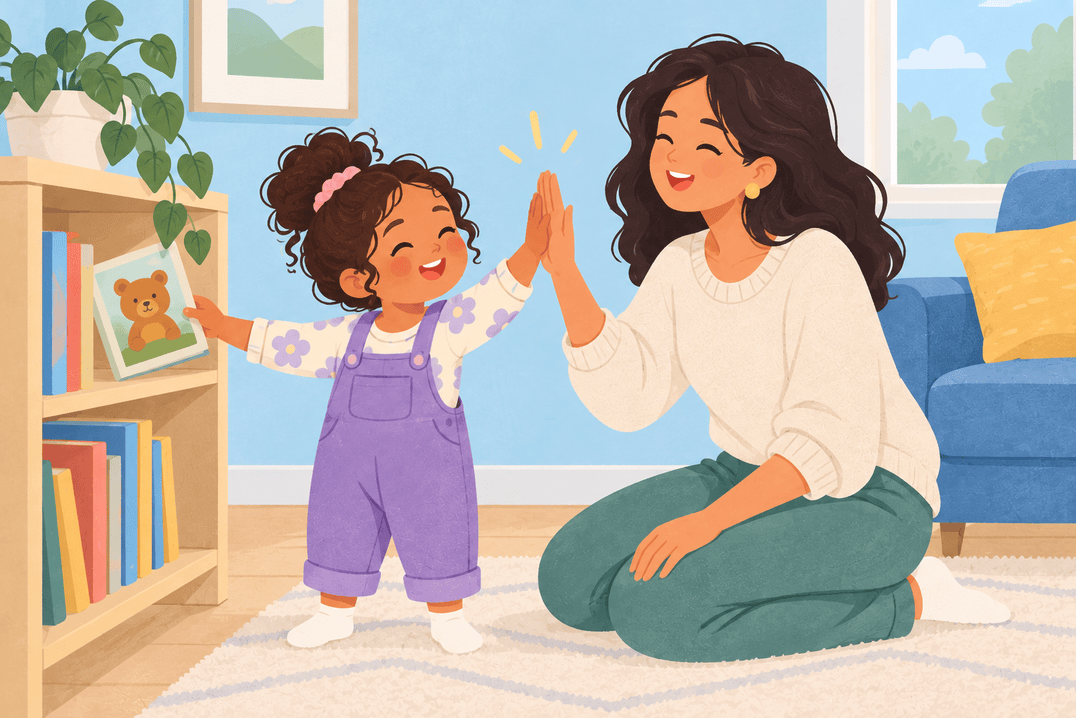
It is easy to spend a busy day saying what needs to stop. Positive attention makes room to notice the actions you would like your toddler to practise again: handing you a cup, waiting briefly or using a gesture to ask for help. It works best as part of a warm relationship, not a system in which a child has to earn affection.
Start with something small that your child can already attempt. The aim is to make the helpful action understandable.
Describe the action you noticed
Instead of a general label such as “good girl,” say what happened: “You moved your foot so I could put your sock on.” Keep the wording short enough for your child to connect it with the moment.
Praise an effort as well as a finished task. A toddler who places one block in a basket with your help is participating in cleanup. There is no need to compare that effort with a sibling or follow it with criticism about yesterday.
Choose goals within your child’s control
Asking for help with a word or gesture is a practical skill to notice. Never crying, always sharing or staying dry all night are poor targets for a toddler reward system. Those expectations can confuse developing abilities with deliberate choices.
For example, during play you could notice that your child handed over a ball for a turn. Our sharing guide explains why short supported turns are more realistic than expecting unrestricted sharing of every favorite toy.
Include attention that has no conditions
Make room for ordinary shared play even after a difficult morning. Let your child choose between suitable safe activities and follow their interest for a little while. You might describe the tower they are building or copy the sound they make with a toy vehicle.
This time does not need an expensive activity or constant questions. Put aside distractions when you can, notice what your child is doing and allow pauses. A smile or quiet comment may suit a child better than loud celebration or physical affection they do not want.
Keep rewards simple if you use them
Specific praise may be enough. If you try stickers or a simple chart, choose one achievable action and explain it plainly. Give recognition soon after the action, rather than requiring a whole day of perfect behavior that is hard to understand.
If the plan is not helping, check whether the goal is realistic and the instructions are clear. The transition guide can help with tasks that involve several steps. Increasing the prize does not solve pain, confusion or an impossible expectation.
Attention does not replace protection or comfort
Do not ignore danger, injury, illness or genuine distress in an effort to reinforce behavior. Stop harm immediately and support the child who is upset. The hitting guide describes a calm safety response.
Meals, drinks, necessary care and reassurance remain available. If you respond sharply, repair the moment when calm and return to the plan. Positive attention is a repeatable way of teaching and connecting, not a promise that your toddler will stop having difficult feelings.
References
- CDC: Using praise and rewards (opens in a new tab)
- CDC: Play that follows your child’s lead (opens in a new tab)
- CDC: Redirecting attention and its limits (opens in a new tab)
- American Academy of Pediatrics: Healthy discipline strategies (opens in a new tab)
- NHS Best Start in Life: Helping toddlers with emotions (opens in a new tab)

Lifeing Editorial
Stories for a little more understanding, a little more reassurance, and the everyday moments in between.
Related posts
Pregnancy with a coil: Why a Positive Test Needs Prompt Assessment