
Salt and sugar in baby food: Reading Labels and Planning Meals
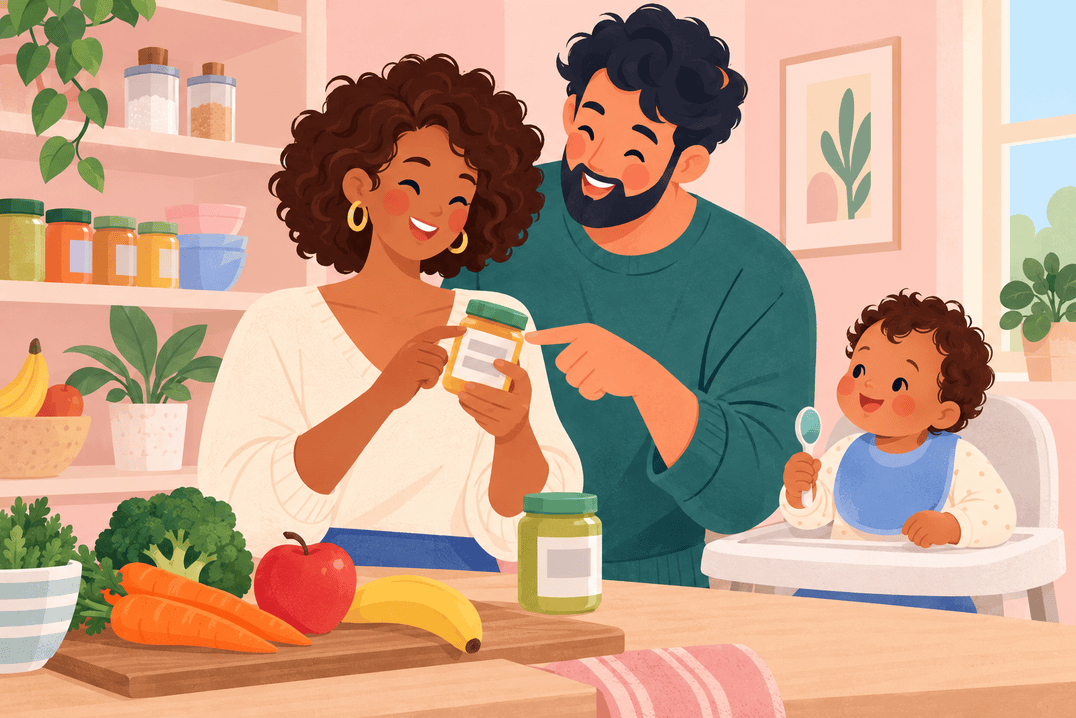
A pouch labelled natural or a snack sold for babies can still contain ingredients you would rather limit. Reading the back of the pack gives you more useful information than the picture on the front. You do not need to calculate every mouthful to make sensible everyday choices.
Start with simple ingredients
Babies do not need salt added to their meals or cooking water. Stock cubes, gravy and prepared sauces can add considerable salt even when you have not used a salt shaker. Take out your baby’s portion before seasoning the rest of a family meal.
Choose a variety of suitable foods rather than trying to build a perfect menu from packaged baby products. Our first food guide includes ordinary ingredients that can be prepared simply. Convenience foods can still be useful; comparing similar products helps you choose between them.
Understand the two sugar questions
Total sugar includes both naturally occurring sugar and sugar added during production. Plain milk, plain yogurt and fruit can contain natural sugar without having sugar added. The total sugar number alone does not tell you to remove these foods.
On a US Nutrition Facts label, look at the added sugars line as well as total sugars. On other labels, the ingredient list may be especially useful. Added sugars can appear as sugar, syrups, honey or other sweetening ingredients. A claim such as no refined sugar does not necessarily mean no added sugar.
Avoid adding sugar to baby meals or choosing sweetened drinks as an everyday habit. Honey also has a separate safety restriction before the first birthday, explained in our honey guide. It is not a suitable workaround for table sugar.
Compare like with like
When two similar foods list nutrients per 100 grams, use that column for a fair comparison. Comparing one manufacturer’s small serving with another’s larger serving can be misleading. Check whether the salt or sodium number refers to the same amount of food.
The serving pictured on a packet is not a portion your baby must finish. Adult reference intake percentages are not infant nutrition targets either. Our portion guide explains how offers can remain small and responsive as your child grows.
Keep the whole meal in view
A useful shopping choice might be plain full fat pasteurised yogurt rather than a sweetened version, or beans without added salt rather than beans in a salty sauce. Continue to check that the texture and ingredients suit your baby, including any known allergy.
Do not turn label reading into a low calorie or low fat diet for a baby. Growing children need energy and nutrients as well as sensible limits on salt and added sugar. If a restricted diet, poor growth or a medical condition makes food choices difficult, ask a paediatric dietitian to help you balance those needs.
References
- CDC: Foods and drinks to avoid or limit (opens in a new tab)
- NHS: Foods to avoid giving babies and young children (opens in a new tab)
- FDA: Added sugars on the Nutrition Facts label (opens in a new tab)
- NHS: Food labels (opens in a new tab)
- British Dietetic Association: Complementary feeding statement (opens in a new tab)

Lifeing Editorial
Stories for a little more understanding, a little more reassurance, and the everyday moments in between.
Related posts

Screen time for toddlers: Choosing Limits and Shared Use