
Clear stretchy discharge: What It Can Tell You About Your Cycle

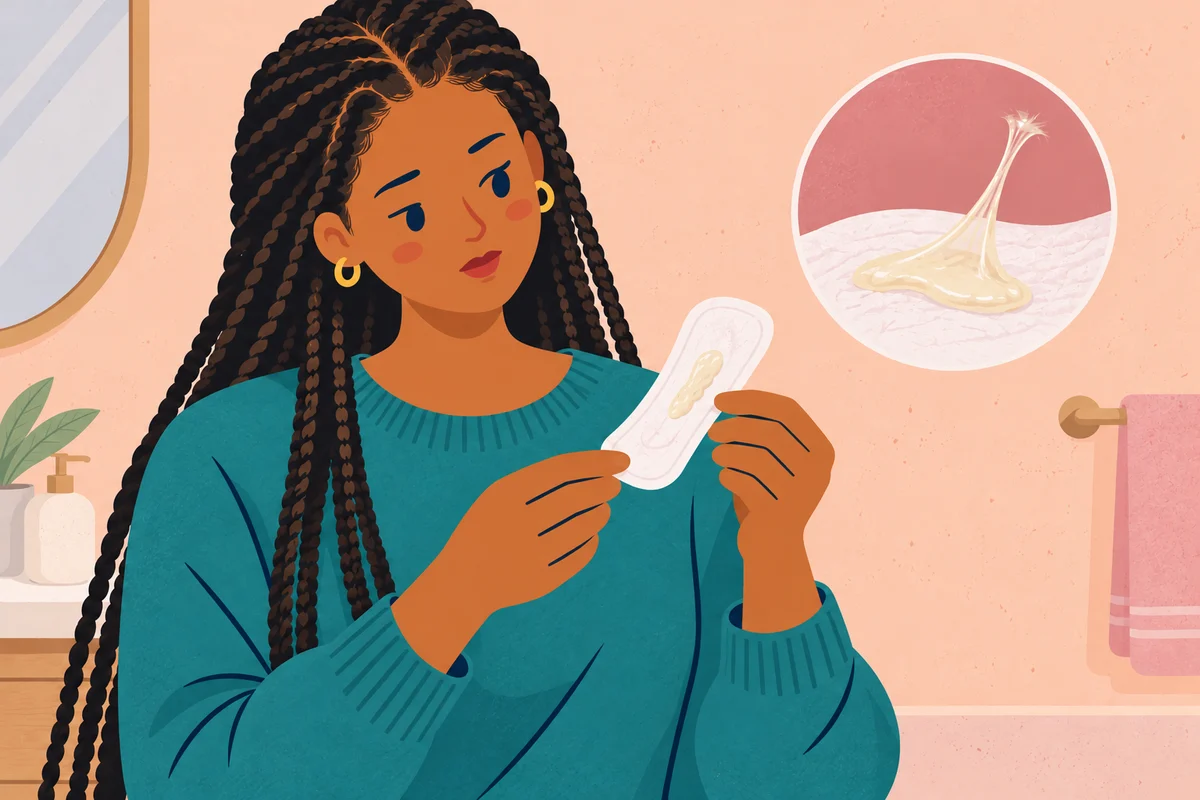
Clear, slippery discharge can be part of an ordinary cycle. It may become more noticeable near ovulation, when the cervix produces wetter mucus. The appearance can provide one observation about your cycle, but it cannot identify the exact moment an egg is released.
Notice the pattern without making a prediction
You might describe mucus as stretchy, wet, or similar to raw egg white. You do not need to measure how far it stretches or compare it with a photograph. A brief note about what you noticed and the date is enough for a general record.
Our guide to discharge throughout the cycle explains the broader range of normal appearances. A day with less visible mucus does not, on its own, establish a fertility problem.
Separate observation from contraception
A taught fertility awareness method has specific rules and may combine discharge observations with temperature and cycle records. Looking at mucus once, or relying only on an app prediction, is not the same as following that method.
If avoiding pregnancy matters, discuss an appropriate contraceptive method with a trained professional. Fertility awareness does not prevent sexually transmitted infections. Condoms can help reduce that risk.
If you are trying to conceive, the fertile window guide puts observations into a wider context. Avoid making sex dependent on finding one perfect mucus appearance.
Look beyond clarity and stretchiness
Clear fluid does not guarantee that an infection is absent. New itching, burning, an unpleasant odor, pain when urinating, or pain during sex warrants advice even if the discharge looks familiar. Some infections produce few or no symptoms.
A clinician considers symptoms, sexual history, examination findings, and appropriate tests together. Home acidity tests and visual comparisons cannot identify every cause of discharge changes. The swab testing guide explains what a sample can help establish.
Keep care simple
There is no need to wash inside the vagina to remove mucus. Douching can disturb its normal bacterial environment and complicate assessment of symptoms. Gentle external washing is sufficient.
Bring a short record if the pattern concerns you, including medicines, contraception, and any discomfort. You can ask for help without first deciding whether the change is hormonal, infectious, or related to fertility.
Using fertile mucus observations when trying for pregnancy
The wetter, more slippery pattern often described as egg white discharge can be a useful clue that fertile days may be approaching. It is not a guarantee that ovulation will occur, and pregnancy does not require you to see that exact appearance. Estrogen changes help explain the pattern, but the amount you notice is not a hormone measurement.
If you use this information for timing, consider the pattern over several days alongside the wider cycle rather than waiting for one ideal sample. Semen, sexual activity, some medicines and vaginal products can complicate interpretation. Note those circumstances instead of assigning a definite ovulation date from appearance alone.
A later shift toward thicker or less noticeable mucus may fit the next phase of the cycle. Our guide to mucus after ovulation explains why that change still cannot confirm pregnancy. If slippery discharge appears in several separate episodes, the repeated mucus guide can help you prepare questions without diagnosing repeated egg release.
References
- NHS: Vaginal discharge (opens in a new tab)
- NHS: Natural family planning (opens in a new tab)
- CDC: Conditions causing vaginal symptoms (opens in a new tab)
- Office on Women’s Health: Douching and vaginal care (opens in a new tab)
- ACOG: Fertility awareness and reproductive timing (opens in a new tab)
- ASRM: Optimizing natural fertility (opens in a new tab)

Lifeing Editorial
Stories for a little more understanding, a little more reassurance, and the everyday moments in between.
Related posts

Coil insertion: Preparing for the Appointment and Aftercare