
Eleven month old baby: Preparing for the First Birthday Transition

The approach to a first birthday can create a long list of things a baby is supposedly meant to stop or start. At eleven months, preparation can be simpler: review feeding, make dental care routine and gather questions about development. Most useful changes are gradual and do not need to happen on the birthday itself.
Continue the current milk plan
Before twelve months, breast milk or infant formula remains the main drink alongside meals. Do not replace it early with cows’ milk simply because the birthday is close. Ordinary cows’ milk used in cooking is a different question from making it the main drink.
If your baby uses a prescribed formula or has growth or allergy concerns, ask the care team about the next stage. A general age guide should not override that plan. Our milk transition guide explains the questions worth discussing before changing what you buy.
Make cups familiar without a sudden cutoff
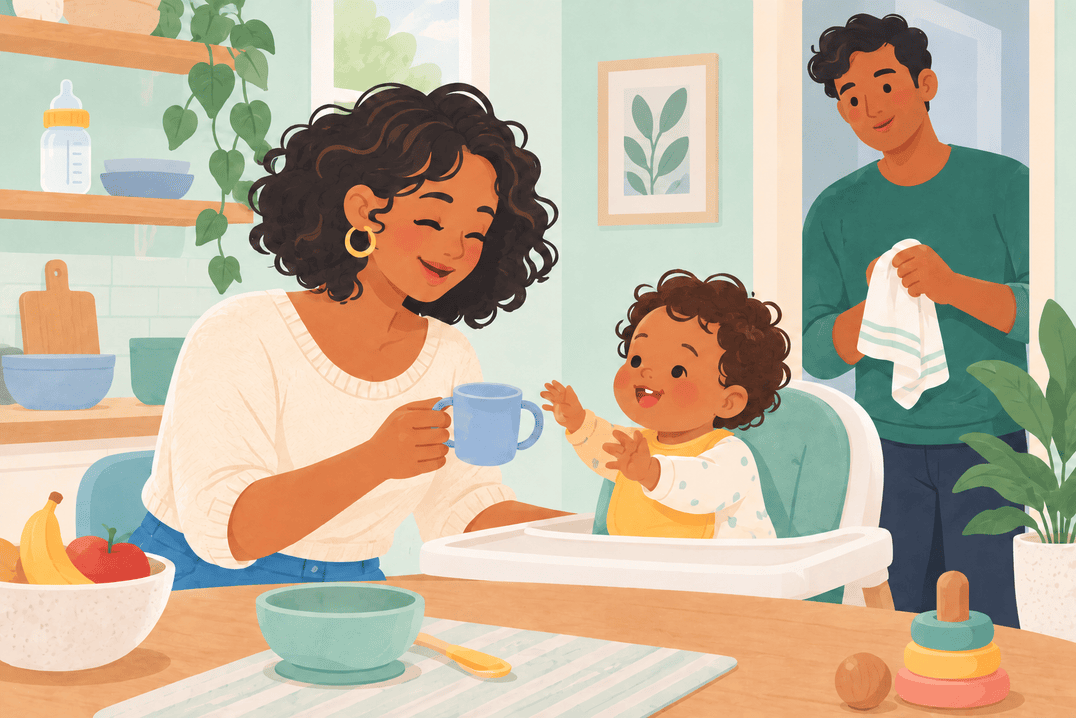
Offer supported cup practice during meals. Small amounts and adult help can keep practice manageable. Spilling is not a reason to abandon a cup, and finishing a full drink independently is not the test of success.
The bottle to cup guide describes a gradual transition. The paediatric guidance used here generally aims to complete this between twelve and eighteen months, with adaptations for individual needs. Do not abruptly withhold needed fluids to enforce a deadline. Continue breastfeeding if it suits you and your child; moving from a bottle is not the same as stopping breastfeeding.
Start dental care before there is a full set of teeth
Brush from the appearance of the first tooth, using a small soft brush and a smear of fluoride toothpaste. An adult does the brushing, twice daily, including before bed. Letting a baby hold a brush can be part of the routine, but it does not replace cleaning the teeth.
Arrange a dental visit if you have not already done so. The paediatric dental recommendation is to establish care by the first birthday. Ask about local access early, especially where waiting lists are long, and seek advice sooner for pain or a visible dental concern.
Prepare observations for the next review
At one year, developmental observations include waving, using a special name for a parent, putting an object in a container and pulling up to stand. These examples help you watch ordinary activities. They are not a requirement to rehearse until your baby performs at a party.
Keep a short note of things you want to discuss, including feeding comfort, responses to sounds or movement that seems difficult. Our ten month guide explains how to support exploration without rushing milestones.
Choose one practical change at a time
You might begin by making the toothbrush easy to find or agreeing a cup routine with another caregiver. A manageable change is easier to keep consistent than a complete household reset.
Missing earlier skills or losing an ability needs discussion now. The birthday can be a useful reminder to review care, but it should never become a reason to postpone help when something concerns you.
References
- NHS Best Start in Life: Feeding from ten to twelve months (opens in a new tab)
- NHS: Drinks and cups for babies and young children (opens in a new tab)
- American Academy of Pediatrics: Moving from bottles to cups (opens in a new tab)
- NHS: Looking after your baby’s teeth (opens in a new tab)
- American Academy of Pediatrics: Preventing cavities and the first dental visit (opens in a new tab)
- CDC: Developmental milestones at one year (opens in a new tab)
- CDC: Getting help with developmental concerns (opens in a new tab)

Lifeing Editorial
Stories for a little more understanding, a little more reassurance, and the everyday moments in between.
Related posts

Embryo freezing: Understanding Storage and Future Use