
Newborn Spots: When a Rash Needs a Medical Check
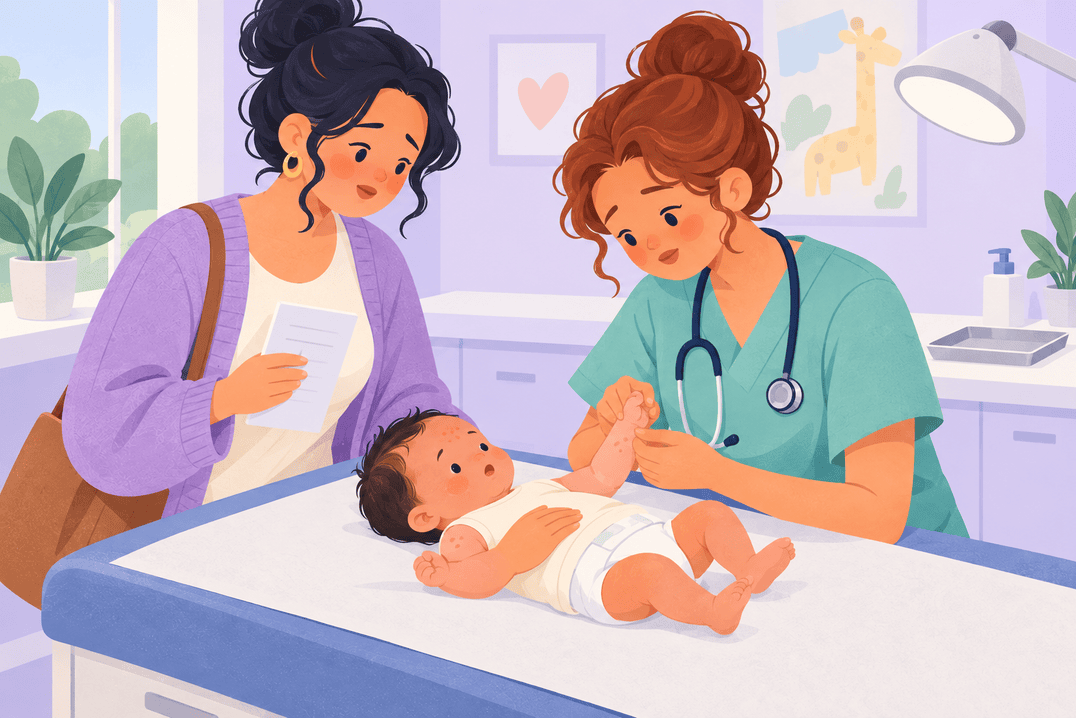
A new patch of spots can be surprising when you are still getting to know your newborn. Some early skin changes settle without treatment, but a photograph cannot tell you whether a rash is harmless. Your baby’s age, feeding, temperature and behaviour matter as much as the appearance of the spots.
If you are uncertain, ask your midwife, health visitor or baby’s clinician to look. Do not wait for a routine appointment if your baby seems unwell or the skin is blistering, painful or spreading quickly.
Some common spots need very little care
Tiny pale bumps called milia can appear on a young baby’s face. They usually disappear without treatment. Another common early rash, erythema toxicum, can produce blotches with small pale or coloured bumps that come and go during the first weeks. A clinician can help distinguish these from conditions that need treatment.
Acne can also appear in the early weeks, often on the cheeks or nose. It commonly clears on its own. Acne that first develops after about six weeks deserves assessment because other conditions may resemble it, and some infant acne needs treatment to prevent scarring.
These examples are not a checklist for making a diagnosis at home. Spots can look different across skin tones, and two rashes with similar photographs may have different causes. A familiar name should not override a change in how your baby is acting.
Leave the spots alone
Do not squeeze, pick or scrub bumps. Gentle washing with lukewarm water is enough while you arrange advice. Avoid adult acne washes, spot treatments, exfoliants and medicated creams unless your baby’s clinician recommends them. Adding a rich oil to acne can also worsen it.
You do not need to remove every mark before a visit or family photograph. Ordinary newborn skin peeling is another change that should not be scrubbed away. Greasy scalp scales have a different care routine, explained in the cradle cap guide.
Blisters and illness need a different response
Contact a clinician urgently for new fluid filled blisters, sores near the eyes or inside the mouth, worsening redness or swelling, or skin that leaks fluid. A newborn with poor feeding, unusual irritability or a rash that concerns you also needs prompt advice.
Herpes infection is uncommon but can be serious in a young baby. It can sometimes follow contact with a cold sore, and a baby may become ill without obvious blisters. Mention any known exposure, but do not wait until you can identify one before getting help. People with a cold sore should not kiss your baby.
A temperature of 38°C or higher in a baby under three months needs immediate medical assessment. Call your local emergency service for breathing difficulty, a baby who is floppy or hard to wake, blue or grey colouring, a seizure, or a rash that does not fade under pressure. The rash and urgent symptoms guide explains why waiting for more spots is unsafe when a baby is unwell.
Make the history easy to share
Note when you first saw the spots, where they started and whether they changed after a product was applied. Tell the clinician about feeding and wet nappies as well as the skin. A photograph can document a change, provided taking it does not delay care.
After assessment, ask what improvement should look like and which changes mean you should call again. That gives you a clearer plan than repeatedly comparing your baby’s skin with images online.
References
- NHS: Rashes in babies and children (opens in a new tab)
- American Academy of Dermatology: Acne in babies (opens in a new tab)
- NHS: Neonatal herpes (opens in a new tab)
- NHS: When to get urgent medical help for babies and children under five (opens in a new tab)
- American Academy of Dermatology: Caring for baby skin, hair and nails (opens in a new tab)

Lifeing Editorial
Stories for a little more understanding, a little more reassurance, and the everyday moments in between.
Related posts
Newborn visitors: Planning Rest, Hygiene, and Family Boundaries