
Peanut introduction: Questions to Ask if Your Baby Has Eczema

If your baby has eczema, the question is not simply whether to offer peanut. The severity of the eczema, any egg allergy and your baby’s readiness for food help determine when and how introduction should happen. Raise the question early so an assessment does not become an unnecessary delay.
Ask how your baby’s risk is classified
US NIAID guidance recommends considering peanut introduction at four to six months for babies with severe eczema, egg allergy or both, after appropriate clinical evaluation. This is a specific prevention pathway, not an instruction for every baby to begin solids at four months.
Babies need to be developmentally ready and able to manage other solid food first. General infant feeding guidance still centres on starting solids around six months. For mild or moderate eczema, peanut is commonly introduced around six months, and routine testing is not required for every baby.
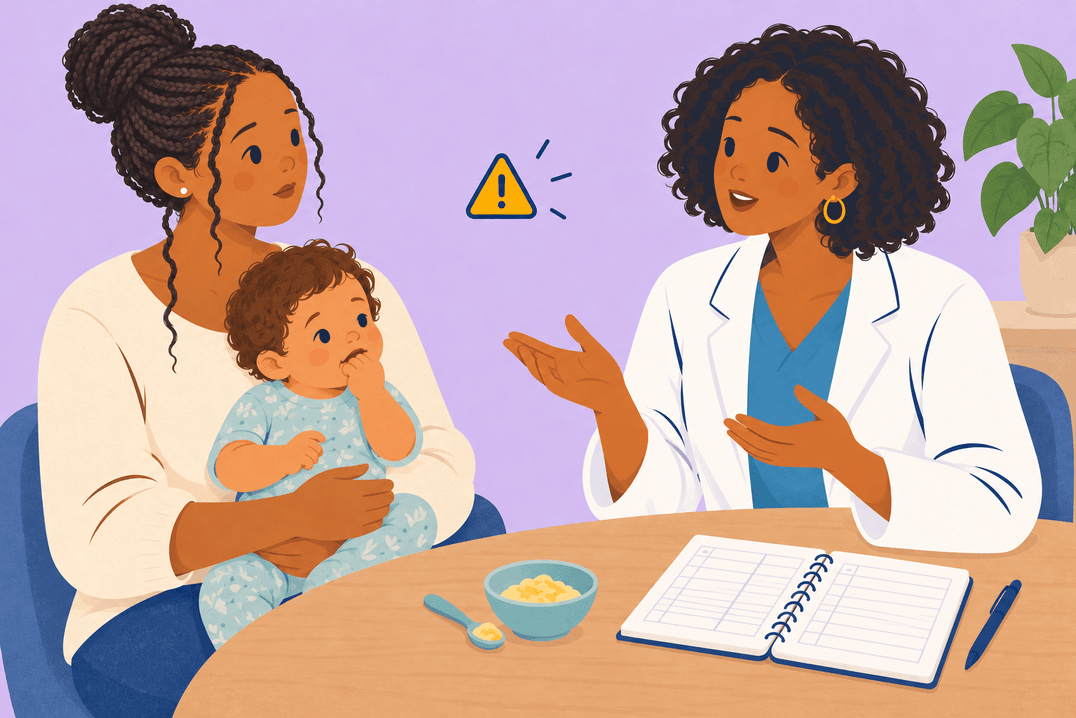
Ask your clinician, “How severe is the eczema, and does our baby need assessment before peanut?” Describe the skin symptoms and treatment, rather than trying to classify severity from a photograph online.
Understand what assessment may involve
The team may recommend targeted testing, a supervised introduction or a home plan, depending on the history and results. A positive test is not permission to try peanut at home. The clinician must interpret what the result means and whether peanut should be avoided pending further assessment.
A baby who has already reacted to peanut needs evaluation of that reaction. Early introduction advice does not serve as treatment for an established allergy. Do not attempt to build tolerance by giving increasing amounts after symptoms.
Confirm the practical plan
Before starting, clarify the timing, suitable preparation, amount and place of introduction. Ask what symptoms should prompt a call and which require emergency action. If a supervised appointment is advised, ask how to arrange it promptly and what to do while waiting.
Our general allergen guide explains how new foods can fit into a varied menu. Having eczema does not mean that all allergenic foods should be excluded indefinitely.
Keep the texture safe
Whole peanuts and chunky peanut pieces are choking hazards for young children. Thick spoonfuls of peanut butter can also obstruct the airway. Use the preparation your clinician recommends, such as smooth peanut butter thinned into a suitable familiar food.
Seat your baby upright and stay with them. If peanut is tolerated, continue it regularly according to the agreed plan. A first taste does not remove the need for an ongoing routine or guarantee lifelong protection.
Separate prevention from emergency care
Our food allergy symptoms guide explains what to record after a suspected reaction. Serious breathing symptoms, tongue or throat swelling, collapse or marked floppiness require immediate emergency help.
If your child has prescribed emergency medicine, follow their action plan. Our severe reaction guide explains why waiting for a rash or trying another mouthful is unsafe when emergency signs are present.
References
- NIAID: Peanut allergy prevention guidelines for parents (opens in a new tab)
- American Academy of Pediatrics: Peanut allergies and early introduction (opens in a new tab)
- ASCIA: Infant feeding and allergy prevention guideline (opens in a new tab)
- BSACI: Allergy prevention (opens in a new tab)
- CDC: Choking hazards (opens in a new tab)
- NHS: Anaphylaxis (opens in a new tab)

Lifeing Editorial
Stories for a little more understanding, a little more reassurance, and the everyday moments in between.
Related posts

Pelvic ultrasound for infertility: What the Scan Looks For