
Sixteen month old toddler: Helping Curiosity Meet Safe Boundaries

A sixteen month old can be interested in everything an adult would rather keep out of reach. Curiosity is useful, but understanding a short instruction is not the same as reliably stopping an impulse. Your job is to make exploration safer and keep limits simple enough to repeat calmly.
Start with the environment
Check what your child can now reach, open or use as a step. Secure furniture and televisions, keep medicines and cleaning products locked away and remove accessible cords. A closed cupboard is not necessarily a secure cupboard once a toddler discovers the handle.
Put bags containing medicines or small objects somewhere inaccessible, including visitors’ bags. Review gates and window protection as movement changes. These measures reduce the number of situations that rely entirely on a toddler remembering what you said a moment ago.
Give a brief instruction and practical help
If your child reaches for something unsafe, move it or guide them away and state the limit simply. You might say, “That is hot. Come here with me.” A long explanation in the middle of the moment is unlikely to make the setting safer.
Offer an acceptable alternative when one is available. An age suitable toy can replace an unsafe object; a safer play area can replace climbing near a window. Keep the boundary consistent across caregivers so the child is not faced with a different rule each time.
Allow feelings without changing a safety limit
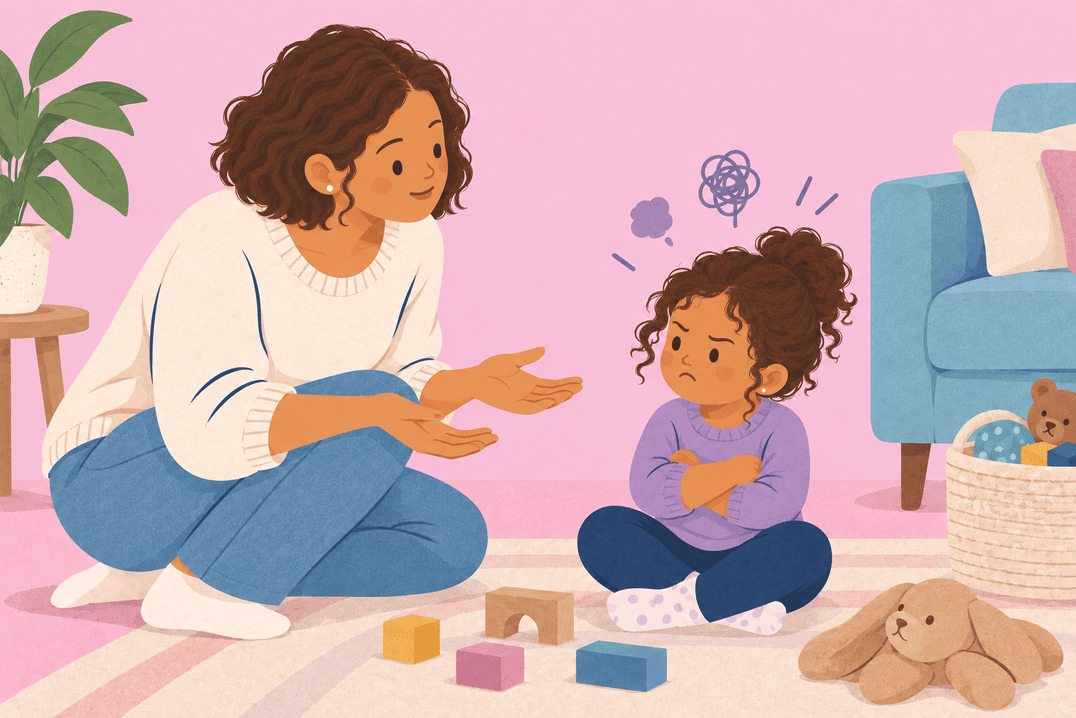
Your toddler may protest when you intervene. Stay nearby, name the feeling in a few words and offer comfort while keeping the unsafe option unavailable. Being upset does not mean the limit was unnecessary, and a limit does not require shouting or hitting.
Our guide to big feelings has more detail. If you feel close to losing control, ask another trusted adult to take over safely when possible. Ongoing difficulty coping is a reason to seek support, not to keep struggling alone.
Leave room for small choices
Choices work best when either answer is acceptable. Let your child choose between two safe toys, rather than asking whether they want to do something that must happen. You can recognise a gesture or reach as an answer; choosing does not require clear speech.
Our toddler play ideas offer activities that can fit within those boundaries. You do not need a room full of equipment to give a child something worthwhile to explore.
Keep development separate from behaviour labels
Sixteen months falls between the fifteen and eighteen month checkpoints. Our fifteen month guide explains the earlier observations, including early independent steps, pointing for help and word attempts beyond parent names.
If earlier skills are absent, an ability is lost or you are concerned about hearing, movement or communication, ask your clinician now. Do not assume a child is ignoring you deliberately or wait for eighteen months before raising a difficulty. Everyday examples can help distinguish a safety problem, a communication need and a developmental concern.
References
- CDC: Developmental milestones at fifteen months (opens in a new tab)
- CDC: Developmental milestones at eighteen months (opens in a new tab)
- NHS: Baby and toddler safety (opens in a new tab)
- US Consumer Product Safety Commission: Preventing furniture and television tip overs (opens in a new tab)
- American Academy of Pediatrics: Positive discipline and consistent limits (opens in a new tab)
- NHS Best Start in Life: Helping toddlers with emotions (opens in a new tab)
- CDC: Getting help with developmental concerns (opens in a new tab)

Lifeing Editorial
Stories for a little more understanding, a little more reassurance, and the everyday moments in between.
Related posts

Skin to skin after cesarean birth: Discussing Your Preferences