
Twenty four month old toddler: Looking at Development Around Age Two
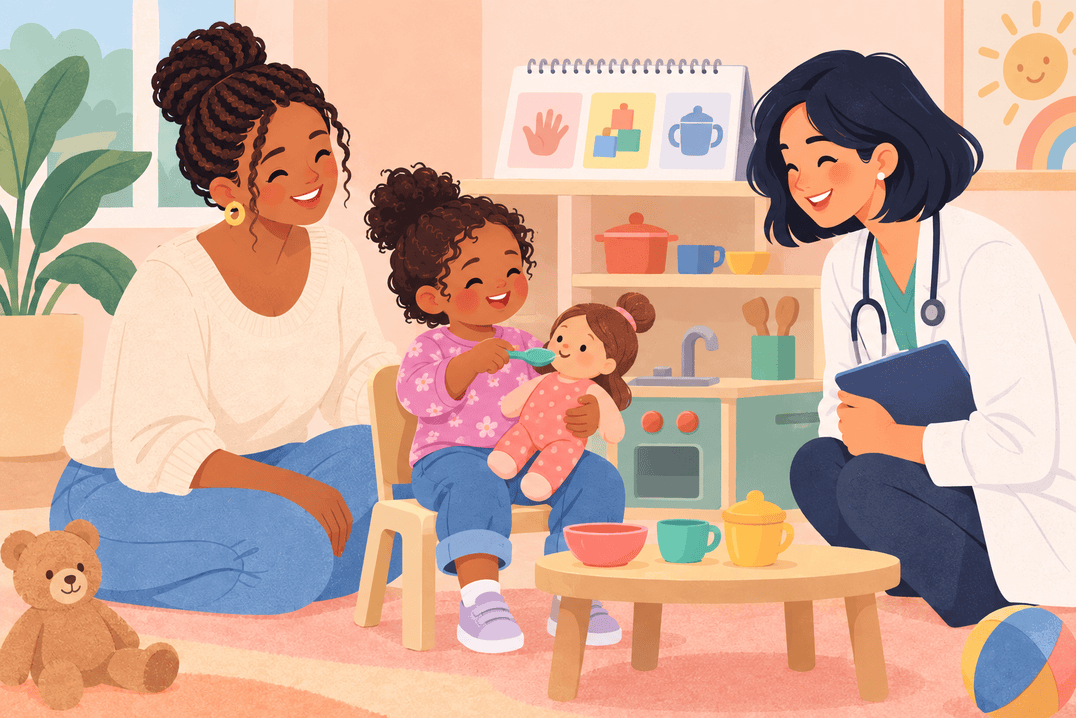
At twenty four months, development is best considered across everyday life rather than through one number or one skill. How your child communicates, plays, moves and responds to other people all matters. A review can bring those observations together and identify where more support may help.
Look at communication in context
The two year checkpoint includes putting at least two words together, pointing to familiar things in a book and identifying at least two body parts when asked. It also includes gestures beyond pointing and waving, such as a nod or a blown kiss.
Our vocabulary guide explains why word counts alone do not tell the whole story. Mention what your child understands, how they request things and whether words are used meaningfully in daily situations. A concern should not wait until a particular count is reached or missed.
Include movement and play
The checkpoint also includes running, kicking a ball, walking up a few steps with or without help and eating with a spoon. Using both hands together to manage an object and combining more than one toy in play are useful observations.
These examples are not instructions to leave a toddler alone on stairs or provide unsafe objects. Offer suitable opportunities with supervision. If your child has physical support needs, ask how the assessment and activities should be adapted.
Notice social responses without making a diagnosis
Looking to an adult’s face in an unfamiliar situation and noticing that another person is upset are part of the two year guidance. Describe what you observe across familiar situations, including any change from before.
A single missed response does not diagnose autism or another condition. Equally, one skill that seems reassuring does not settle all concerns. Developmental history, observation and appropriate assessment are considered together.
Ask about screening and hearing
In the United States, autism screening is routinely recommended at twenty four months. The general developmental screening schedule includes other ages, and additional screening can be offered whenever there is a concern. Local arrangements outside the United States differ.
Screening identifies whether further evaluation may be needed; it does not provide a diagnosis by itself. If communication is a concern, hearing may need assessment too. Our hearing guide explains why responding to some sounds or passing a newborn screen does not settle a later concern.
Agree what happens next
Tell your clinician about missing skills, difficulties in daily activities or loss of an established ability. Ask who will arrange further assessment and how you should follow up. If your child was premature, discuss their history and how developmental age is being considered rather than applying an adjustment indefinitely yourself.
While waiting, continue shared play, books and responsive conversation in the languages you use comfortably. These are opportunities for connection, not substitutes for a referral. If reassurance does not resolve your concern, return with specific examples and ask for further review.
References
- CDC: Developmental milestones at two years (opens in a new tab)
- CDC: Getting help with developmental concerns (opens in a new tab)
- American Academy of Pediatrics: Language delays and assessment (opens in a new tab)
- NHS: Health and development reviews (opens in a new tab)
- American Academy of Pediatrics: Corrected age for premature babies (opens in a new tab)
- NHS: Helping your baby learn to talk (opens in a new tab)
- NHS Best Start in Life: Playtime and bonding with toddlers (opens in a new tab)
- NIDCD: Speech, language and developmental assessment (opens in a new tab)

Lifeing Editorial
Stories for a little more understanding, a little more reassurance, and the everyday moments in between.
Related posts

Twenty month old toddler: Everyday Learning Through Play