
Twenty month old toddler: Everyday Learning Through Play
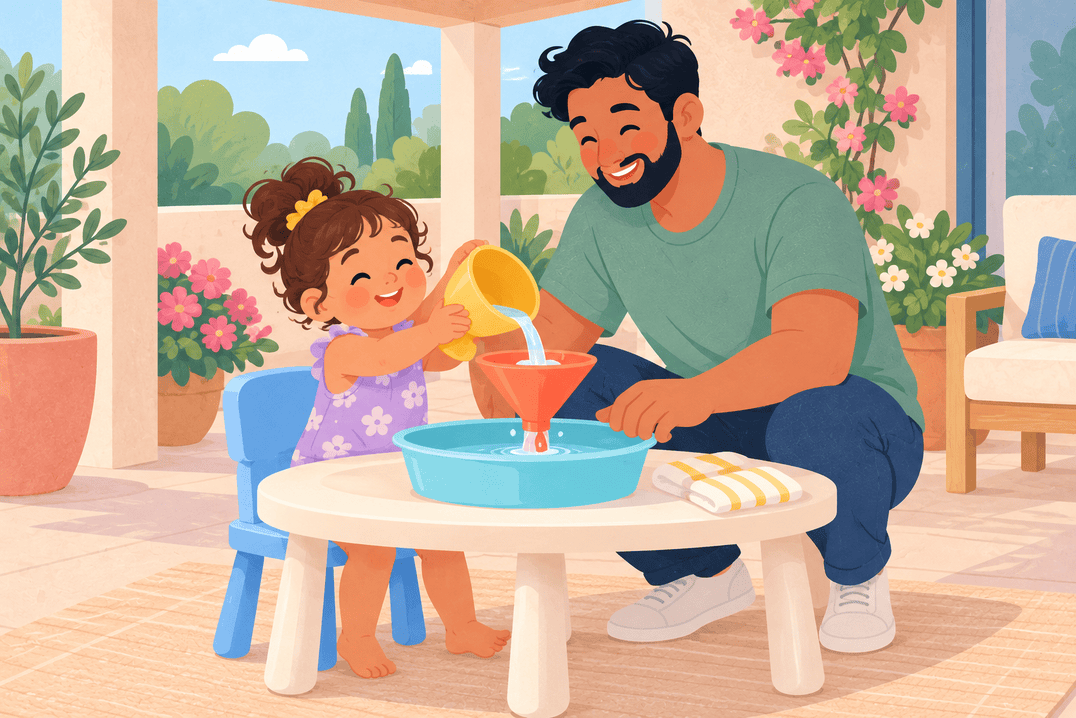
Everyday learning at twenty months can happen while a toddler investigates a container, watches you put away clothes or returns to a favourite picture book. You do not need a formal lesson plan. A useful activity gives your child something safe to explore and an adult who notices their interest.
Begin with what your child is doing
Watch for a moment before introducing a new idea. If your toddler is moving an age suitable toy between containers, you can name where it goes or offer another safe container. Let them keep repeating an action if they are engaged.
Our toddler play guide offers starting points you can adapt. The aim is participation, not a finished craft or a photograph of a correctly completed activity. Stop or simplify when the task becomes frustrating.
Include simple pretend actions
You might pretend to feed a doll with an appropriate toy spoon or make a toy vehicle travel to a pretend destination. Follow your child’s response rather than requiring a detailed story. Our pretend play guide explains how these early actions can develop.
Check materials carefully. Small pretend food pieces, loose batteries and broken parts are still hazards. A toy suitable for an older sibling is not automatically appropriate for a toddler, even when an adult plans to sit nearby.
Let movement be part of the day
Offer a safe space to move and a suitable ball to roll or try kicking. Adjust the activity to current ability and stay close enough to help. Walking outside can involve stopping to look at something rather than covering a set distance.
Choose equipment intended for your child’s age and supervise its use. Do not create a risky climbing route to practise a milestone. If movement seems painful, unusually difficult or different from before, seek advice rather than increasing the amount of practice.
Add words without turning play into a quiz
Describe a familiar action with a short phrase and pause. If your child contributes a sound or word, respond naturally. During shared reading, you can talk about one picture without finishing the book or asking for every object to be named.
Background noise can make listening harder, so reduce it when possible. You do not have to narrate continuously. A quiet pause can leave room for your child to draw your attention to something.
Keep expectations tied to established checkpoints
Twenty months sits between the eighteen month and two year developmental checkpoints. There is no separate compulsory twenty month list in the guidance used here. The upcoming two year observations include combining two words, running and using a spoon, alongside social and play skills.
Do not wait for two years if earlier skills are missing, a skill is lost or something concerns you. Share examples with your clinician and ask whether assessment is needed. Enjoyable play can continue while you seek help, but it should not be presented as a cure for an unexplained developmental difficulty.
References
- CDC: Developmental milestones at eighteen months (opens in a new tab)
- CDC: Developmental milestones at two years (opens in a new tab)
- NHS Best Start in Life: Playtime and bonding with toddlers (opens in a new tab)
- American Academy of Pediatrics: The power of play (opens in a new tab)
- NHS: Helping your baby learn to talk (opens in a new tab)
- NHS: Baby and toddler safety (opens in a new tab)
- CDC: Getting help with developmental concerns (opens in a new tab)

Lifeing Editorial
Stories for a little more understanding, a little more reassurance, and the everyday moments in between.
Related posts
Twenty nine month old toddler: Understanding Changing Sleep and Behavior