
Six month old baby: Solids Readiness and Supported Play

Six months often brings two practical questions: whether your baby is ready for food, and how to support increasingly active play. These changes do not require a strict daily programme. Start with your baby’s abilities, make the setting safe and leave room for help when something feels difficult.
Check readiness before the first meal
Solid foods usually begin around six months. Look for the combined abilities to stay sitting with a steady head, coordinate reaching towards the mouth and swallow food rather than push it straight out. Extra waking or chewing a fist alone does not show readiness.
Our first foods guide explains how to begin. If your baby was premature, cannot maintain a safe feeding position or has a medical feeding plan, ask your clinician for individual advice. Do not improvise a reclined feeding arrangement to meet a birthday deadline.
Make a small, practical food plan
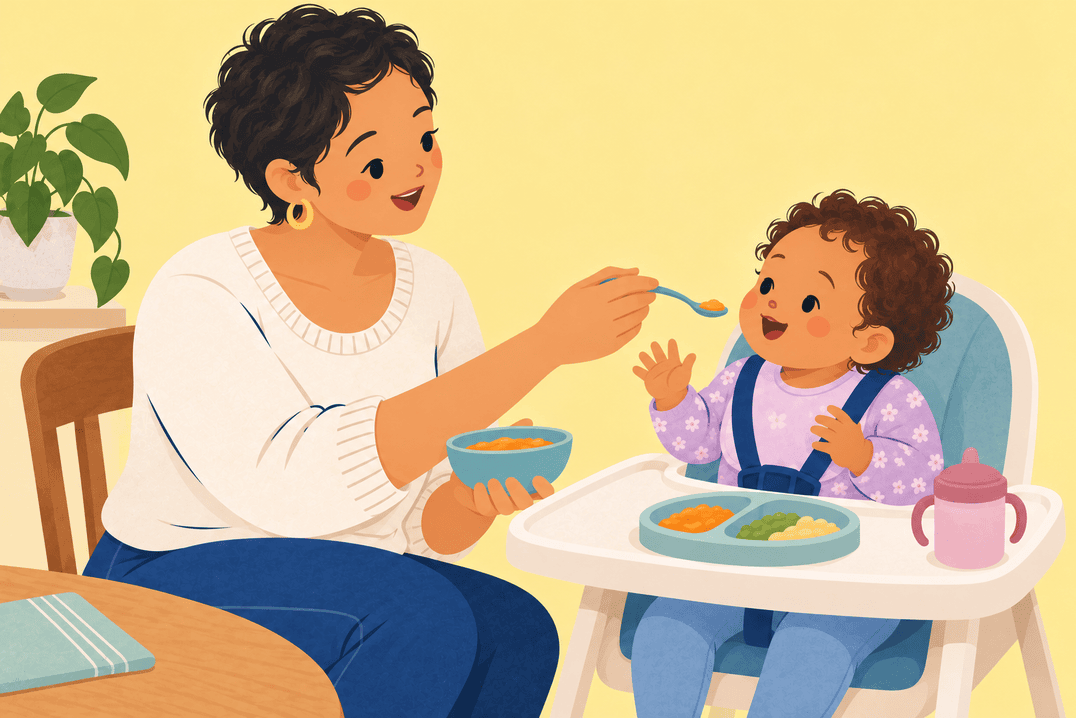
Choose a calm opportunity when you can sit nearby throughout the meal. Your baby should be alert and upright in a suitable secured chair. Offer a little food, allow time and stop when they turn away or close their mouth. Milk feeds continue as solids are introduced.
Include foods containing iron as variety develops, such as appropriately prepared meat, lentils or iron fortified cereal. Food needs a suitable texture and shape; a hard piece does not become safe simply because it is small. Avoid whole nuts and thick spoonfuls of nut butter.
Plan allergenic foods thoughtfully
Common allergenic foods can generally be introduced from around six months, individually in small amounts so a reaction can be noticed. Keep tolerated foods in the diet. Our allergenic foods guide covers this separately, including circumstances needing advice before introduction.
If your baby has eczema, a diagnosed allergy or a family history of allergic disease, discuss the plan with a clinician. Do not attempt a home challenge after a suspected reaction. Breathing difficulty or swelling of the tongue or throat after food needs emergency help.
Let play follow the skills you see
The six month developmental checkpoint includes reaching for a wanted toy, exchanging sounds, laughing and rolling from tummy to back. Leaning on the hands while sitting is also included; independent sitting is not the requirement at this age.
For sitting practice, use safe floor opportunities with nearby support as needed, rather than leaving your baby balanced on a raised surface. Respond to their sounds and offer an intact age suitable toy to explore. You can pause or change activity when interest fades.
Use concerns to guide the next conversation
A checklist helps describe development; it cannot diagnose a condition. Ask about missing skills, persistent feeding difficulty or anything else that concerns you. Loss of an ability deserves prompt assessment rather than waiting for another monthly guide.
Bring specific examples: whether head control changes when tired, what happens during a meal or which movements seem difficult. Those observations are more useful than comparing your baby with a short video of somebody else’s child.
References
- CDC: Developmental milestones at six months (opens in a new tab)
- NHS: Your baby’s first solid foods (opens in a new tab)
- NHS: Food allergies in babies and young children (opens in a new tab)
- NHS Best Start in Life: Preparing food safely (opens in a new tab)
- NHS Best Start in Life: Feeding from seven to nine months (opens in a new tab)
- CDC: Getting help with developmental concerns (opens in a new tab)
- American Academy of Pediatrics: Corrected age for premature babies (opens in a new tab)

Lifeing Editorial
Stories for a little more understanding, a little more reassurance, and the everyday moments in between.
Related posts

Sixteen month old toddler: Helping Curiosity Meet Safe Boundaries